Although James 3 is a famous passage imploring us to be careful with the use of our tongues, the whole of this letter admonishes us to bridle our tongues (James 1:19, 26; 2:12; 3:5-8; 4:11; 5:12). We have already considered that godly thoughts lead to godly actions, that the believer is to love God under trials and to be doers as well as hearers of the word of God and not to show partiality and that faith without works is dead. Now it is time to consider controlling the tongue.
Using the tongue wisely
Notice that James/Jacob says much about the tongue but commences with advice for teachers. Teachers will have a stricter judgement (James 3:1), since they are given more responsibility and more is required from them. The teacher must exemplify what they teach or no one will take them seriously and will merely utter, “hypocrite”! There is grave responsibility in teaching faithfully and living consistently. Their tongues are to be employed to steer the congregation in the same way that a rudder steers a ship, keeping it on its correct course. That is not to discourage anyone who possesses a genuine teaching gift, but to approach that business soberly.
Let us consider that James writes with humility to “my brethren” although he was the Lord’s (Yeshua’s) half-brother. He also writes “we all stumble in many things”. In relation to wisdom, the book of James is frequently compared with Proverbs. In Solomon’s prayer of dedication in the temple, he declared, “for there is no one who does not sin” (1 Kings 8:46). Similarly, David stated in Psalm 53:1, “there is none who does good”.
However, if anyone does not stumble in word, he is a perfect man, able to bridle the whole body. The word ‘perfect’ here is ‘telios’ (Strongs ref. 5046), meaning mature, complete, full grown and something for believers to aim towards. He is able to bridle the whole body. A similar point is stated in James 1:26, “If anyone among you thinks he is religious, and does not bridle his own tongue but deceives his own heart, this one’s religion is useless.”
A pilot steers the ship (James 3:4) and a pastor guides and shepherds the flock willingly and not by compulsion. In relation to speech, an elder must be temperate, sober minded, of good behaviour and not quarrelsome. Part of their task from Titus 1:10-11 is to deal with idle talkers whose mouths must be stopped, who subvert whole households teaching things which they ought not, for the sake of dishonest gain.
James 3:2 applies to all of us and James states that we all stumble in many things. What can be done? More positively, if the tongue can be controlled then great evil can be averted. Moreover, we can grow in the Lord and employ our tongues as an instrument of blessing, not cursing. Self-control is a fruit of the Holy Spirit. To control our tongues, we must control our thoughts. But how do we control our thoughts? By taking every thought captive to the obedience of Messiah. And by being guided by the Holy Spirit seeking godly wisdom above human wisdom.
Never underestimate the influence of the words that you speak. Remember, “For out of the abundance of the heart the mouth speaks.” (Matthew 12:34) Think of the value of instruction at the home or in the congregation or encouraging another to come along to the congregation. The warm greeting that someone receives at the meeting hall is vital. Some will deliberate anticipating their arrival. Another may use their tongue wisely and give someone a tract, or the Scriptures and graciously ask, “If you were to die tonight, would you be certain of going to heaven?”
James/Jacob considers the need to control the untameable tongue by providing us with a variety of natural illustrations. Firstly, a bit is put in horse’s mouths so that they can obey us and the whole body can be controlled. Think of the term ‘horsepower’ and how a powerful and majestic creature is under control by using a small piece of metal in the horse’s mouth. Of itself, the tongue in appearance is diminutive, seemingly powerless, though it is employed to great effect albeit for good or evil.
Next, reflect on huge ships being directed in vast oceans among perilous natural elements. It is a wonder that such a large and impressive vessel is guided by the relatively tiny rudder. If a ship travels a far distance, even if it moves at merely one degree off course and continues to do so, it will never arrive at the intended destination. Similarly, teachers will need to steer the ship of the congregation, avoid obstacles and keep a look out. Teachers help to keep the congregation steering them towards the Scriptures and are to be guided by the Holy Spirit. Also, in the same way that the rudder controls the ship, teachers and believers need to be able to control their tongues.
The mature believer in Ephesians 4:14-15 is no longer like children, “tossed to and fro and carried about with every wind of doctrine, by the trickery of men, in the cunning craftiness of deceitful plotting, but, speaking the truth in love, may grow up into all things in Him, who is the head-Christ.”
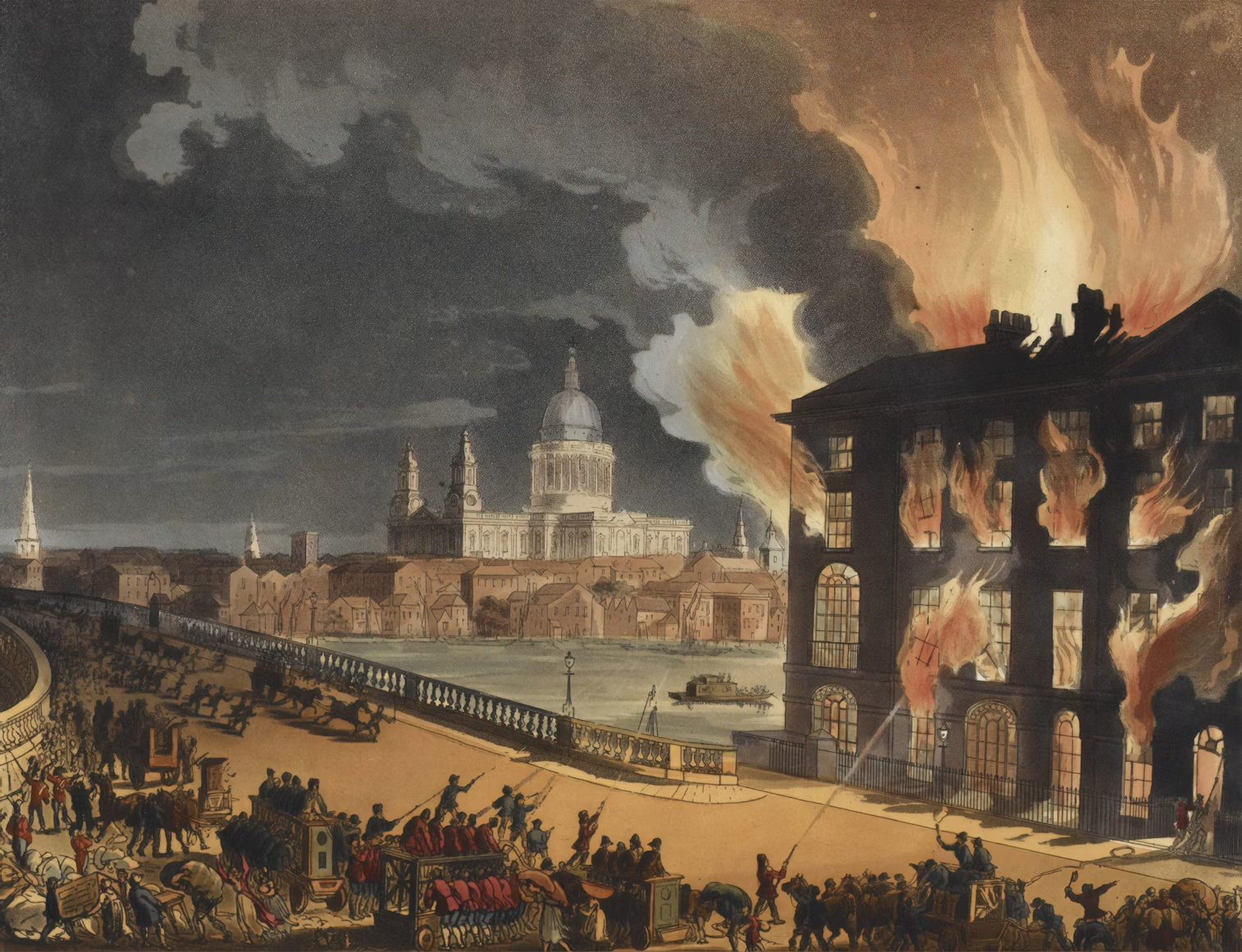
The tongue is small and boastful and see how great a forest a little the fire kindles! On Sunday 2nd September, 1666, the Great Fire of London started in a baker’s shop on Pudding Lane ironically from the home of Thomas Farriner, a church warden. Although he claimed to have extinguished the fire, three hours later at 1pm, his house was blazing in flames. It then destroyed 13, 200 houses, 87 parish churches, the Royal Exchange, the Guildhall and St Paul’s Cathedral.[i]
Notice this did not originate from malicious intent, or desire to harm, but simply through carelessness. How much more should we be careful of loose talk or careless words that catch like wildfire? During WWII, posters were used to guard against loose talk such as, “Loose lips might sink ships”. “Telling a friend means telling an enemy”. “An enemy may be near, stop all loose talk to strangers!” “A careless word…A needless sinking.” “Lest we regret-Don’t talk!”
We have daily and even hourly choices to determine how we govern our speech. Do you govern your speech and when was the last time you bridled your tongue? Solomon spoke of this frequently concerning contrasts and polar opposites and blessings and cursings.
“There is one who speaks like the piercings of a sword, but the tongue of the wise promotes health.” (Proverbs 12:18)
“The tongue of the wise uses knowledge rightly, but the mouth of fools pours forth foolishness.” (Proverbs 15:2)
“An ungodly man digs up evil, and it is on his lips like a burning fire.” (Proverbs 16:27)
David stated, “May the Lord cut off flattering lips, and the tongue that speaks proud things,” (Psalm 12:3)
It may only take a few years for someone to learn to talk, though a lifetime to undo their words. Can your words be deleted or the damage caused be quickly erased? A sharp tongue cuts deeply. So, how can you control your tongue? By looking to God’s holiness and having a fear of the Lord. Think of Isaiah who saw the Lord when the Lord’s glory filled the temple and he recognised that he was one of unclean lips. The seraphim took a live coal from the altar, touched his lips with it and his iniquity was taken away and his sin purged. (cf. Isaiah 6:1-7). We can and must make an effort to curb our tongues, but we need to first look to the Lord, seek His forgiveness and obey Him. If it registered constantly in our minds that the Lord is near to us, we would be much more careful with our words.
The tongue defiles the whole body, sets on fire the course of nature and is set on fire by hell. Think of the damage done by politicians through lies, distorted facts and being economical with the truth. Consider journalists presenting merely one aspect of an event, concealing the context and the use of propaganda. Think how different law courts would be, if people told the truth, the whole truth and nothing but the truth. Wiersbe observes thoughtfully that, “For every word in Hitler’s Mein Kampf, 125 lives were lost in WWII.[ii]
The tongue set on fire by hell refers to Gehenna Valley of Hinnom, south of Jerusalem. Continual burning of rubbish made it an apt illustration of the lake of fire. Do you see why gossiping, idle speech, slander and accusing speech are of grave concern? We must guard our speech. So, pray often that the Lord would help you not to stumble in word and that you might be a blessing and not a curse.
One may marvel at how every kind of beast, bird and reptile and creature of the sea can be tamed. I used to watch in awe at the late Steve Irwin at how he interacted with wild animals. Do you fear the most ferocious beasts and poisonous reptiles? They can be tamed. If we could see the poison in our tongues, we would be swift to hear, slow to speak and slow to wrath (James 1:19). We venture to safari parks in the safety of our cars, but not on foot. I remember going on a walking safari and the guard had a gun, not to shoot the surrounding creatures we wished to admire, but to avert them in the case of a sudden unpredictable encounter. Would we let all the potentially dangerous creatures loose in a meeting hall? Well then, should we not guard our tongues all the more?
A blessing not a curse
William MacDonald has simple, yet profound and practical advice. All that we say should be subject to the threefold test: Is it true? Is it kind? Is it necessary?[iii]What would this look like if we heeded that instruction? It may or may not mean we say less, but it does mean we would think before we speak. It will probably involve a conscious effort to say more things that are helpful and not a hindrance. It might mean that we may start a sentence and not finish that sentence. It will mean that the believer will present a more consistent and faithful testimony, pleasing to the Lord. It will encourage others who do not know the Lord to consider our faith more seriously. The Lord is able to tame our tongues and to help us employ our tongues wisely and that is both a mercy and a blessing.
Sadly, sometimes our tongue is used to bless God, yet at other times we curse others made in the likeness of God (James 3:9). How does that happen and how can we change? Do we bless the Lord in a meeting, but curse others in the workplace who antagonise us? Do we bless God in prayer, but curse others at home because they irritate us? Do we bless God in song, yet speak evil of those who hold opinions contrary to our ones? Irrespective of how others might behave, they have been created in the similitude of God. Though we have wronged them, of greater offence is that we have sinned against a holy God. We would do well to regularly remind ourselves, that though we cannot visibly see God, He is with us.
Fructenbaum helpfully cites Midrash Rabbah on Genesis 5:1. “In effect when one curses another man, who was made in the image of God, he is also issuing a curse against God as well. This is the low use of the tongue. The rabbis had a similar concept: “One could not say, ‘Let my neighbour be put to shame; for then you put to shame one who is made in the image of God.’”[iv]
There is salvation in Messiah
A rhetorical question is asked whether a spring produces fresh and bitter water from the same opening? What use is a spring that produces fresh and bitter water? The water would not be fresh. This reminds us of the congregation in Laodicea whose water supply was lukewarm and that was a graphic picture of their spiritual health. The solution is to go to Messiah who gives living water so we will never thirst again. Therefore, with joy you will draw water from the wells of salvation (Isaiah 12:3). Yeshua means salvation. Have you found salvation in Him?
We began by thinking about controlling our tongues and considering that teachers will receive a stricter judgement. It was prophesied of Yeshua (Jesus) seven hundred years before His first coming, “Nor was any deceit found in His mouth (Isaiah 53:9). He is the only human of whom that can be said, since He lived a perfect life and His speech was also entirely pure. He was the only One who could forgive sin and through His precious blood, made atonement for sin. Even Nicodemus the teacher of Israel referred to Him as “Rabbi, we know that you are a teacher sent from God; for no one can do these signs that You do unless God is with him” (John 3:2). A talmidim (disciple) stays close to their rabbi, they spend time with them and eventually they become like them. If you would be a disciple of the Lord Jesus, you must draw close to Him as Messiah, turn to Him, trust in Him and follow Him and you will become more like Him. Are you one of His disciples?
James/Jacob is one of the Messianic Jewish epistles. James speaks of fig trees, olive trees and the grapevine, all indicative of Israel. To bear good fruit through our words, it is imperative that we are firmly connected to the root, since real and genuine change occurs on the inside and is something that only Messiah can accomplish in us. Jesus is the vine and His believers are the branches. Without Him we can do nothing. Are you connected to Messiah?
Hence a fig tree cannot bear olives and a grapevine cannot bear figs and no spring yields both salt water and fresh water. We need the living water. On the last day of the Feast of Tabernacles, which was accompanied by the water ceremony Jesus proclaimed, “If anyone thirsts, let him come to Me and drink. He who believes in Me, as the Scripture has said, out of his heart will flow rivers of living water.” (John 7:38) Have you come to believe in Him?
If you want to control your tongue you must be controlled and guided by the Holy Spirit. Abide in Yeshua, the true vine. That way you be a blessing and not a curse and will bear fruit that is pleasing to Him.
[i] London Fire Brigade The Great Fire of London https://www.london-fire.gov.uk/museum/history-and-stories/the-great-fire-of-london/
[ii] Warren W. Wiersbe The Wiersbe Bible Commentary The complete NT in one volume (David C. Cook, 2007; Colorado Springs), p868
[iii] William MacDonald Believer’s Bible Commentary (Thomas Nelson, 1995; Nashville), p2233
[iv] Arnold G. Fructenbaum Ariel’s Bible Commentary The Messianic Jewish Epistles Hebrews-James I&II Peter-Jude (Ariel, 2005; San Antonio), p282


