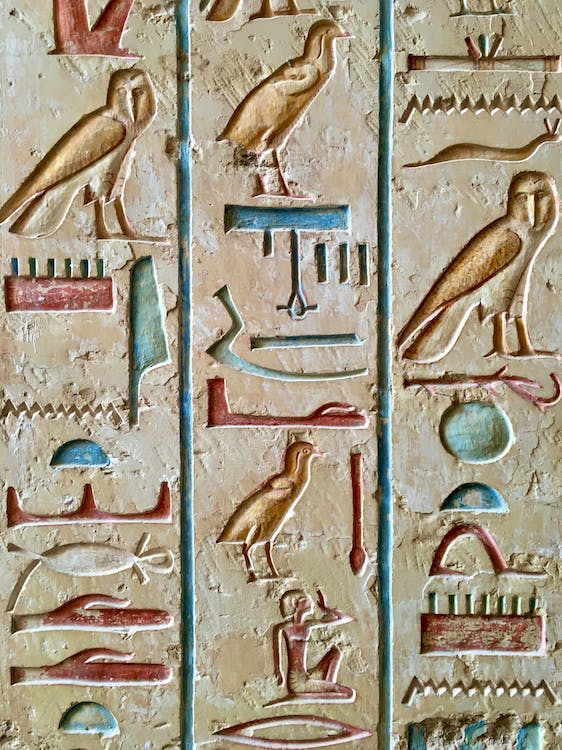
Syncretism involves mixing the holy with the unholy, the godly with the ungodly and the sacred with the profane. The golden calf episode is the epitome of syncretism and cow worship in various forms, is still prevalent today. I remember being engrossed in a school project about Egypt and sketching the gold death mask of Tutankhamun. There was a sense of wonder and fascination about the Ancient World and the Egyptians storing exquisite objects in pyramids. My sense of adventure was aroused when I learnt about Howard Carter’s remarkable discoveries. What can you see? “Wonderful things!” Our teacher described the exhibition in London a few years earlier that we missed! I was envious, but there was a new replica exhibition in Dorchester just twenty or so miles down the road.
I ventured to the Tutankhamun Museum not really comprehending what I was gazing at, though I was still excited and mesmerised and so I returned. Last year I was able to identify a few items of biblical interest and had a eureka moment. There was an artefact labelled ‘The Golden Cow’. I immediately made the connection since this exhibit was from the time period of an Egyptian dynasty congruent with the golden calf of Exodus 32.
Tutankhamun came from the 18th dynasty, roughly 1539-1292BC. Many who argue for the early date for the Exodus say Tuthmosis III, 1479-1425BC was the pharaoh of the Exodus. Those arguing for a late date state Ramases II 1279-1213BC was the pharaoh of the Exodus. Tuthmosis III and Tutankhamun both lived in the 18th dynasty in Egypt. In room 4 in the British Museum, there are artefacts relating to all three of those pharaohs. Have you wandered and wondered by the River Thames and noticed Cleopatra’s Needle? The inscription actually honours Tuthmosis III. Have you been for a stroll in Paris and stopped to look more closely at the Place du Concorde? That inscription is a tribute to Ramases II.
Cultural cow worship
There is more to be seen than the first glance when we consider the golden calf. It is more specific than simple idolatry, since it points to the prevalence throughout the ages and into our current times concerning cow or bull worship. Let us consider a few cultures across the globe today. Think of the Masai in East Africa whose cattle is their livelihood. Cattle hides are used for temporary shelters, walls, roofs, bedding and clothing. Cattle dung is used for a plaster to make permanent homes. Even blood is in their diet and they also consume beef, drink cow milk and fashion utensils from their bones, such as knives or spoons. The cattle are not worshipped but are integral to the community. Traditionally a dualistic monotheistic god is worshipped with both a favourable and a vindictive character. Positive attributes include bringing grass, prosperity, thunder and rain. Negative aspects consist of factors such as famine and hunger. The Ten Plagues of the Exodus and especially the plague on livestock would be of particular interest to the Masai.
In the United States, there are certain areas where there are cowboys and cowgirls. Sometimes we hear the unholy expression “holy cow” which may derive from this text in Exodus. Whilst cows are not generally worshipped in America, there are three million Hindus residing there. In Hinduism, cows are sacred and beef is definitely off the menu and cows are respected. There are approximately 1.2 billion Hindus worldwide and Hinduism is the world’s third largest religion.
In his commentary on Exodus, Alan Cole notes that the sacredness of the bull runs from Baal worship in Canaan to popular Hinduism in South India currently. He adds that it is likely that during Israel’s sojourn in Egypt they may have been influenced by a form of stockbreeder’s fertility cult and that Baal worship from that time is recognised archaeologically and Baal was worshipped by some Semitic peoples inhabiting the delta region.[i]
Cow worship in various places and in the United Kingdom
How does cross-cultural cow worship relate to the United Kingdom today? In 2022, a 10-metre high mechanical bull was the centrepiece of the Birmingham Commonwealth Games. Was that merely a cultural enrichment blended from art, music, dance and pre-games festivities? No, it was more akin to a grotesque form of revelry and history repeated as a modern-day golden calf frenzy. At the Paris Olympics last year, a giant steel horse with a bulls head was also prominent. Remember the original ancient Olympics in 776BC were held in honour of Zeus, so there was more going on than meets the eye.
Years ago, I had another eureka moment in my old hometown as I saw what went on behind the keyhole. I went to a sophisticated home and there was a whole room given to idols. It is not unusual nowadays to see idols in a restaurant, café or hotel, or a Buddha statue at someone’s desk at work. This has crept into our culture under the guise of being fashionable, or of giving the appearance of being ‘enlightened’.
Let us not lose sight that Aaron had the children of Israel build a golden calf and they worshipped it, though the Scriptures are completely opposed to that practise. Sadly, this is still a problem today in parts of Israel, particularly Tel Aviv and amongst some Jewish groups worldwide. Buddhism is especially popular amongst reform Jews and secular Jewish communities and it is not that uncommon to visit temples from the eastern religions or believe in karma. People are spiritually searching and often looking to the New Age or are trying to be more ‘spiritual’. The problem is syncretism by attempting to blend God’s word with other religions. This is of course a problem in many churches today in the United Kingdom noticeably since the 1960’s onwards, whereby eastern religious ideas and philosophies have taken greater prominence.
The roots of syncretism
How did syncretism come about? In Exodus 32, the people saw that Moses delayed when he came down from the mountain. The children of Israel grew impatient and this led to disaster. Equally, we must be careful that our impatience never leads to hastiness resulting in compromise. Consider that Moses was on the mountain for 40 days though Moses was 40 years old before he left Egypt. At the age of 80, Moses returned to Egypt and 40 years later he died having never reached the Promised Land. The children of Israel had been residing in Egypt for 400 years. Are you working according to God’s timescale or your schedule?
If your life seems to be on hold and something you are praying for has not happened yet, continue praying, reading God’s word, obey Him, serve Him, maintain fellowship and continue sharing the gospel. Remember that He knows exactly what you need more than you do, and His timing is more punctual than precise than yours is.
Aaron had an idea. Take off the golden earrings and make a golden calf. Back in Exodus 3:21-22 the Lord promised them gold, silver, and clothing from the Egyptians. They were not left emptyhanded and this was almost a back-payment from Egypt. The children of Israel wisely, obediently and willingly used much of that for the Tabernacle but then used some for the golden calf. This is not merely idolatry but a more subtle form. It is syncretism, the blending of the holy with the unholy and the sacred with the profane.
There is a lie attached as there often is, when people depart from godly service. “This is your god, O Israel who brought you out of Egypt!” (Exodus 32:4) When we are rushed and disobedient, we are also more susceptible to lies and compromise. The Lord delivered the children of Israel from Egypt but something of Egypt remained in Israel. The Ten Plagues graphically demonstrated that the Lord was far greater than the gods that the Egyptians worshipped. The Passover was instituted and it is wonderfully preserved to this day. The children of Israel crossed over the Red Sea and they were given manna from heaven and water from the rock. But with the case of the golden calf, the first lie inevitably led to a greater lie. Aaron responded to Moses that he threw the gold into the fire and out came a calf! What were they thinking and what was happening?
Brian Edwards and Clive Anderson are able to pinpoint the problem. “The plague recorded in Exodus 9:1-7 would have affected the current sacred bulls. It is the worship of the sacred bulls that lies behind the episode of the golden calf in Exodus 32, and Israel were still worshipping a golden calf in the time of Jeroboam I (1 Kings 12:28 & 2 Chronicles 13:8).[ii]
How could Aaron and the children off Israel resort to worshipping a golden calf so speedily? Syncretism. They merged peace offerings and burnt offerings and sat down to eat and drink and rose up to play. This was no innocent picnic. The reliable commentaries unanimously indicate unrestrained revelry. Today we need to distinguish not only truth from error but right from almost right and right from a blended mixture. This is exactly what even the evangelical church needs to be wary of today, to ensure that ungodly practises and teachings do not creep in unawares.
I know a relative of a famous Victorian preacher who likes to indulge in playful conversation about religion. He even listens to the weekly sermons of the current minister of that well known congregation. His ideas are mixed. On the last few occasions, he quizzed me about the Egyptian gods and he favours the hippopotamus god. So, I explained that the false gods that the Egyptians worshipped were used against them in the respective ten plagues. The ancient Egyptians worshipped the River Nile, which was turned into blood, they worshipped the sun and they experienced darkness and they worshipped Serapis the locust god and were afflicted by a plague of locusts. The God of the Bible is the One true God and is sovereign.
The unholy fruit of syncretism
Since the 1970s in this country, there has been an onslaught of eastern, Pagan and New Age practises. Think of George Harrison with his syncretistic song, ‘My sweet Lord’ blending hallelujah in one verse and Hari Krishna in another verse. Note the term ‘Christ consciousness’ is not a biblical term and does not have a biblical meaning either.
Think of yoga and the union with an impersonal force. The union referred to is that of self and cosmic consciousness of a universal spirit. Believers are yoked to the Lord and guided by the Holy Spirit, not by an impersonal spirit. Breathing exercises can include meditation and channelling energy which is the opposite of what the Bible teaches. The idea is to activate chakras, use mantras and release energy which is by no means biblical.
The believer does not empty their mind but rather meditates on God and His word (Romans 12:2; 1 Corinthians 2:16; Ephesians 4:23-24). But what about the health benefits of yoga? The believer should strive to avoid the appearance of evil. Even the exercise positions and the breathing exercises off yoga are in connection with channelling energy. Instead, why not mediate on God’s word and do exercise, eat sensibly and do sports stretching exercises?
Consider the film ‘Avatar’. What does Avatar mean? It means ‘spirit guide’. Who is guiding you? Also, many children’s programs and cartoons involve the occult, witchcraft, mediation, magic and false religion. It would be wise to keep an eye on children’s books, be aware of what is being taught and not taught in schools. Be wary of ‘mindfulness’. It can involve ungodly meditation, breathing exercises and guided imagery.
Be careful of so-called Christian books such as ‘The Shack’. The ‘Great Spirit’ of Native American Indians is confused with the Holy Spirit. The Father is portrayed as an African American woman but the Bible states that no one has seen God at any time (John 1:18). The shack includes a number of heresies and encourages universalism. In ‘The Shack’, Sarayu is a supposedly a personification of the Holy Spirit, depicted as an Asian woman. We need to consider not how we feel about this book, but does it line up with Scripture?
Enter through the narrow gate
Irrespective of our culture or upbringing, everyone needs to enter by the door, though Yeshua (Jesus), through the narrow gate. Why? Because broad is the way, that leads to destruction and there are few who find it. There are only two paths. Which path are you on? This is a matter of life and death. Resolve today to trust in the Lord and enter by the narrow path and do not put it off. If you turn to and trust in the Lord Jesus, you will avoid the wrath of God and have life eternal.
[i] Alan Cole Exodus Tyndale Old Testament Commentaries (IVP, 1973; Leicester), p214
[ii] Brian Edwards & Clive Anderson Through the British Museum with the Bible 5th Edition (Day One, 2015; Leominster), p48