Known as the ‘The Father of Egyptology,’ Flinders Petrie lived a somewhat rugged and spartan existence as he excavated in unbearably scorching conditions and he is famous for being a pioneer of biblical archaeology. In 1883, The Egypt Exploration Fund sent him to excavate around 30 sites where he laboured for most winter seasons until 1926. His custom was to publish a report within a year of his findings.[i] Amelia Edwards was a patron of the Egyptian Exploration Fund and appointed him to her chair of Egyptology at University College, London.[ii]
Just a ten-minute walk from the British Museum, the Petrie Museum is located in the University College, London and is easily accessible and admission is free. Many of the items of biblical interest relate to both museums and are useful for cross-referencing to shed light on particular characters by examining their possessions and documents preserved. Petrie first recognised how pottery could be useful in respect of dating historical objects and he undertook this discipline in a systematic and orderly manner. Hence, it is well-worth a trip for an hour or two to the Petrie Museum if you are able to get to the centre of London.
Sesostris III (Senwosret III)
Sesostris III lived in the 12th dynasty and he would have been the pharaoh ruling Egypt whilst Joseph was prime minister. In the Petrie Museum there is a fragment of an inscription of what appears to relate to Horus with a gold title. Although there is a question mark concerning the identification of the actual object, the essential point is that it relates to Sesostris III. That can also be cross-referenced with the British Museum since there are three dark figurines of him in Room 4, in the large gallery. He is easily noticeable in the British Museum because of his prominent ears and in the same room there is also a large head statute of him and a sphinx with its head removed!
Tuthmosis III
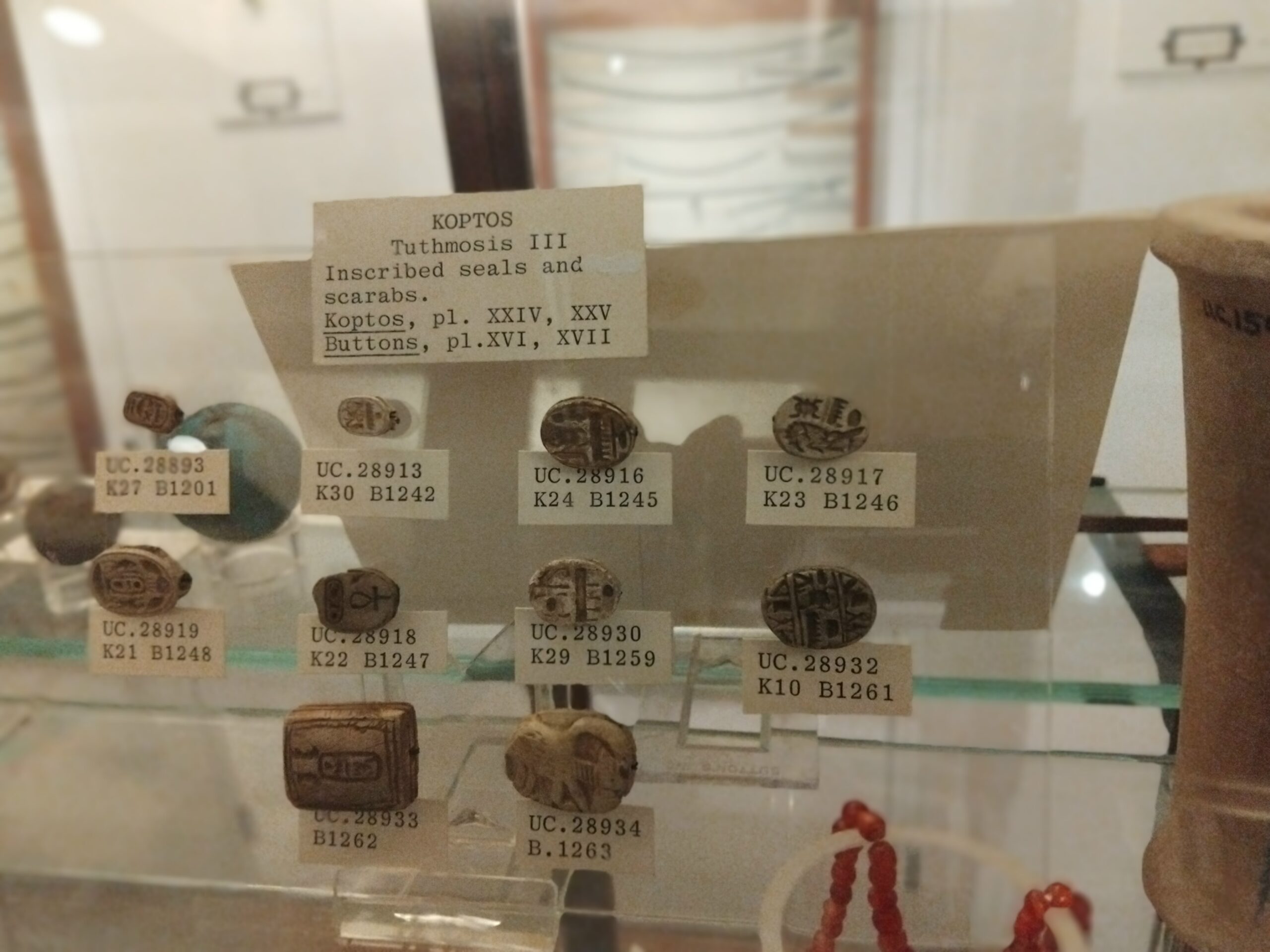
As someone who holds to the early date for the Exodus, Tuthmosis III was almost certainly the pharaoh of the Exodus. There are several items related to him including inscribed seals and scarabs, various temple fragments, a bronze axe with a cartouche of Tuthmosis III, an alabaster cylinder vase with a cartouche of Tuthmosis III and a sandstone grinder with a cartouche of Tuthmosis III. (A cartouche relates to an oval-shaped object and includes the inscribed name of a royal ruler).
In the British Museum there is a much larger figure of Tuthmosis III and looking at the items in both museums helps us to piece information together about him. There are several items of interest relating to Tuthmosis III in the Louvre, a quotation from the annuls of Tuthmosis III in the Ashmolean Museum, Oxford and in the Bournemouth Natural History Museum, there is a bas relief relating to Tuthmosis III and Hatshepsut. Cleopatra’s Needle by the River Thames actually relates to Tuthmosis III (read the inscription next time you walk past there) and the Place de la Concorde was erected in honour of Rameses II.
If you hold to the later date for the Exodus, there is a building inscription of a Ramesside Pharaoh, although it has not been established whether that pertains to Rameses I or Ramases II.
Hatshepsut
This is most likely pharaoh’s daughter who took pity on Moses, both naming him ‘Moses’ and raising him. In the Petrie Museum there are some objects that definitely relate to her and others where it is highly likely she owned them, though there still remains a visible question mark on the caption next to the exhibit.
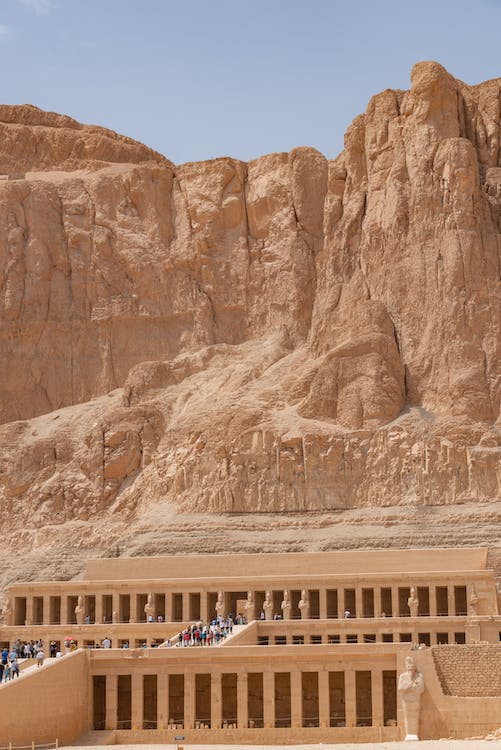
There is a bronze adze blade tied to a wooden handle with leather thongs together with a cartouche of Hatshepsut and dedication to Amun on the handle. Amun is often associated with Tarharqa (2 Kings 19:9) frequently depicted as a ram with Tarharqa tucked beneath him in the British Museum in Room 4 and the Ashmolean Museum in Room 23. In addition, one can see a limestone trial relief of a lion’s head which may or may not relate to Hatshepsut. Either way, it is possible to see Hatshepsut’s obelisk in Room 65 in the British Museum and she has an impressive and magnificent temple on the west bank of Luxor, Egypt.
Nero
Nero is not named in the Scriptures but is the Caesar referred to in Acts 25, 26 and 28:19. He was a notorious ruler who blamed the Christians for the fire in Rome and many of whom, would have been Jewish believers. If one searches through the latter Egyptian dynasties, it is evident that the Persians, Greeks and then the Roman rulers assumed the titles of pharaohs in addition to leading their respective empires.[iii]
So, there is a sandstone fragment with the upper part of a cartouche of Nero and a column of hieroglyphs. Again, a similar phenomenon, can be seen in the British Museum and the Ashmolean Museum. In the British Museum, Tiberius is honouring an Egyptian deity and in the same glass case, Domitian is performing an identical action. In the Ashmolean Museum there is a sandstone stela of the Emperor Nero making an offering as an Egyptian King to the god Min in AD64.
Conclusion
The Petrie Museum is worth a visit since it has a number of smaller artefacts that contribute to our understanding of biblical archaeology. The next step is to compare those artefacts with findings displayed in other museums such as the British Museum, Ashmolean Museum and the Louvre which broadens our understanding further. This crucially illustrates the historical reliability of the Scriptures. The Scriptures point to God who is sovereign over history and who predicts events accurately before they occur. This means that we can trust in the God of the Bible in whom alone salvation is found. The Messiah has come and is coming again. Have you found shalom (peace) with God and will you be ready when He returns?
[i] Allan Millard Treasures from Bible Times (Lion, 1985; Tring), p17
[ii] Chris Sinkinson Clive Anderson Brian Edwards Background to the Bible (Day One, Leominster, 2021), p140
[iii] Teagan Wolter List of Pharaohs of Ancient Egypt https://www.britannica.com/topic/list-of-pharaohs-of-ancient-Egypt