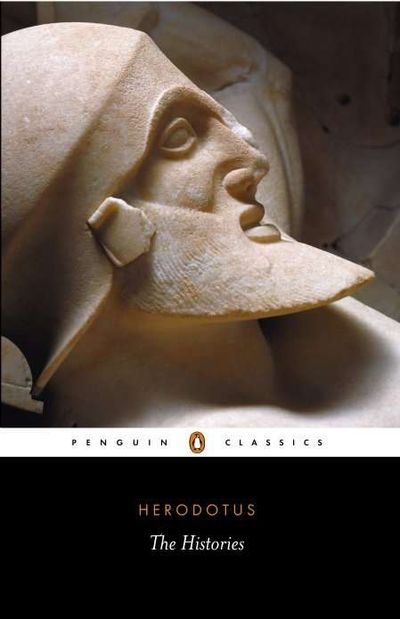
Herodotus (c.490-425BC) was one of the foremost writers in classical literature and some of his historical accounts relate to biblical settings, locations and characters. Cicero famously honoured him with the title, ‘The Father of History’. Although his main focus was the wars and conflict between the Greeks and the Persians, he travelled and wrote extensively, particularly concerning Egypt and Persia and made a few contributions about Assyria, Babylon and other items of biblical interest.
Herodotus records both what he saw and heard, regularly updating the reader on the reliability of those accounts and his evaluation of them. He wrote and commented on both fact and fiction, thus providing historical accounts and culturally derived narratives, but gives reason for doing so. Therefore, he listed important factual information regarding historical figures or rulers but also included the famous outlandish reference about dog-headed men and headless men with eyes in their breasts! In the same paragraph he concisely states (I merely repeat what the Libyans say) and on the next page adds “I merely record the current story, without guaranteeing the truth of it”.[i]
Part way through book two, Herodotus explains to the reader that until that point, he wrote concerning what he had directly observed or researched. Nevertheless, thereafter he was relating accounts from the Egyptians combined with what he saw firsthand.[ii] Later on in book two, he states “Anyone may believe these Egyptian tales, if he is sufficiently credulous; as for myself, I keep to the general plan of this book, which is to record the traditions of these various nations just as I heard them related to me.[iii]
Egypt
Necho II was a 26th dynasty pharaoh mentioned both in Herodotus and the Bible. Assyria was formerly the world superpower, but in 612BC the combined forces of Nabopolassar (father of Nebuchadnezzar) and Cyaxares the Mede overcame Nineveh and Babylon would soon become the leading world empire.
In Herodotus, Necho II is described as succeeding Psammethicus and that he began construction work of the canal to the Arabian gulf that would be completed by Darius the Persian. The construction work is said to have cost the lives of 120,000 Egyptians though he ceased from completing the project when an oracle warned him that it would be to the advantage of the Barbarians. Necho II then shifted his attention to war, built triremes, attacked Syria by land at Magdolus and then went on to take Gaza and was succeeded by Psammis.[iv]
The Scriptures provide eight references concerning Necho II. 2 Kings 23:28-30 provides a succinct account of Pharaoh Necho going to the aid of the king of Assyria, to the River Euphrates and killing King Josiah in battle. Jehoahaz succeeded Pharaoh Necho and did evil in the sight of the Lord. Pharaoh Necho then put him in prison and imposed tribute of one hundred talents of silver and one talent of gold. Necho appointed Eliakim, the son of Josiah king of Judah in place of his father Josiah and changed his name to Jehoiakim. Pharaoh took Jehoahaz to Egypt where he died (2 Kings 23:31-34). 2 Chronicles 35:20-36:1-4 provides a fuller account of the battle were Josiah died and also mentions that Jeremiah lamented him. The reign and captivity of Jehoahaz in 2 Chronicles 36:1-4 parallels that of 2 Kings 23:31-34.
Jeremiah 46 declares judgement on Egypt and verses 1-2 provide the geographic and historical background to these events. “The word of the Lord which came to Jeremiah the prophet against the nations. Against Egypt. Concerning the army of Pharaoh Necho, king of Egypt, which was by the River Euphrates in Carchemish, and which Nebuchadnezzar king of Babylon defeated in the fourth year of Jehoiakim the son of Josiah, king of Judah:”
Pharoah Apries (Hophra) succeeded Psammis (Psamtik II). There is just a single reference to Hophra in the Bible though it is an important one and is consistent with Herodotus’ account. “Thus says the Lord: ‘Behold, I will give Pharaoh Hophra king of Egypt into the hand of his enemies and into the hand of those who seek his life, as I gave Zedekiah king of Judah into the hand of Nebuchadnezzar king of Babylon, his enemy who sought his life.’ ” (Jeremiah 44:30)
Herodotus provides several references to Apries but in connection with the above states that Amasis defeated Apries and Amasis was persuaded by the Egyptians to surrender his prisoner. The Egyptians then strangled him and buried his body in the family tomb in the temple of Athene and subsequently Amasis came on the throne.[v]
Assyria
There are no less than nineteen references to Sennacherib in the Scriptures in the narrative sections of 2 Kings 18-19, 2 Chronicles 32 and Isaiah 36-37. Sennacherib was successful in taking all the fortified cities of Judah and conquering them all with the exception of Jerusalem. Isaiah reassured Hezekiah that the Lord would turn Sennacherib back by the way which he came and that he would not come into the city, nor shoot an arrow there, nor come before it with a shield, nor build a siege mound against it. It came to pass that the Angel of the Lord in one night killed 185, 000 Assyrians and that they went back the way they came.
This is a most astonishing prophecy. The siege of Lachish is the background setting of 2 Kings 18 and is graphically preserved on the stone relief walls in the Assyrian galleries of the British Museum and even includes some weapons used from that battle. The Taylor Prism is viewable in an upstairs gallery and recalls that Sennacherib had trapped Hezekiah like a bird in a cage, though it is clear that the campaign was brought to an abrupt halt.
Herodotus states that when Egypt was invaded by Sennacherib, the king of Arabia and Assyria, not one of them was willing to fight. However, following a dream he believed that if he marched out boldly, he would come to no harm.[vi] Note the reference in 2 Kings 19:9 about Tirharqa king of Ethiopia coming to make war with them! Herodotus oddly writes that thousands of field mice swarmed over the Assyrians at night and ate their quivers, bowstrings and the leather handles of their shields so that the following day, having no arms to fight with they abandoned their position and retreated. In the next sentence regarding those incredulous closing details Herodotus adds, “Up to this point I have relied on the accounts given me by the Egyptians and their priests.”[vii]
Babylon
Herodotus offers much useful historical and contextual insight regarding Babylon regarding the River Euphrates and the supply of bitumen for building the walls of Babylon. The temple is described with mention of a shrine to Bel, together with details of some of its rulers.[viii]
Although Herodotus writes about a range of countries and empires and their respective customs, his main focus is the conflict between Greece and Persia. Significantly during the siege of Babylon, the Persians were able to divert the river into the lake making it passable and gain access to the town. Had the Babylonians known what was happening they might have been able to shut the gates, man the walls and thereby trap them and defeat them, but instead Babylon was captured.[ix]
Persia
Four Persian kings mentioned in the Bible, Cyrus, Darius, Xerxes and Artaxerxes are referenced in Herodotus. At times, several of the names of the respective kings are mentioned in one paragraph thus providing further historical attestation. Out of many examples, one should suffice. “The Delians declared that after his departure the Island was shaken by an earthquake – the first and the last shock ever recorded to my time. It may well be that the shock was an act of God to warn men of the troubles that were on the way; for indeed, during the three generations comprising the reigns of Darius the son of Hystaspes, and of his son Xerxes and his grandson Artaxerxes, Greece suffered more evils than in the twenty generations before Darius was born – partly from the Persian wars, partly from her own internal struggles for supremacy.”[x]
There are nineteen references to King Cyrus in the Scriptures. Isaiah 44:28-45:6 shows how the Lord foretold through Isaiah how Cyrus would be His instrument to enable Jerusalem to be rebuilt and the foundations of the temple laid. 2 Chronicles 36:22-23 and Ezra 1:1-4 shows the fulfilment of that. The Cyrus cylinder confirms that it was his policy to allow those from Babylon to return to their homelands. Book one of Herodotus speaks of Cyrus’ military campaigns but also of his clemency, in particular sparing the life of King Croesus.[xi]
In the book of Ezra, the rebuilding of Jerusalem was opposed though Darius issued a decree enabling the work to continue and the cost to be paid at the king’s expenses and provision to be made with whatever they needed for offerings and sacrifices (Ezra 6:1-12). The temple was completed and dedicated. In addition, the books of Haggai and Zechariah are dated to the second year of the reign of Darius (Haggai 1:1; Zechariah 1:1). Herodotus lists his conquests following those of Cyrus and Cambyses and extending across the whole of Asia other than Arabia.[xii] Herodotus adds that Babylon was captured for a second time and unlike Cyrus, destroyed its defences, pulled down all the city gates and impaled three thousand leading citizens.[xiii]
Xerxes (Ahasuerus) is a central figure throughout the book of Esther and there are also references to the beginning of his reign in Ezra 4:6 and that Darius was his son (Daniel 9:1). In the British Museum overlooking the stairs, there is a relief of him on his throne at Persepolis. One can also view the Apadana columns commenced by Darius and completed by Xerxes in room 52 at the British Museum. In Herodotus there are long accounts of his battles with the Greeks and his enormous army especially with reference to the battle of Thermopylae.[xiv]
In Nehemiah 2, Artaxerxes famously gave permission for Nehemiah to go to Judah to rebuild the walls of Jerusalem. Nehemiah was the cup bearer and some of Artaxerxes drinking vessels are on display in room 52 at the British Museum. At one point in the book of Ezra, Artaxerxes actually gave the order to prevent the Jewish people from completing the work (Ezra 4:17-24). However, the temple was eventually completed and dedicated. “So the elders of the Jews built, and they prospered through the prophesying of Haggai the prophet and Zechariah the son of Iddo. And they built and finished it, according to the commandment of the God of Israel, and according to the command of Cyrus, Darius, and Artaxerxes king of Persia.” (Ezra 6:14) There are fewer references to Artaxerxes in Herodotus[xv], possibly because his reign would have been in the latter stages of Herodotus’ life.
Summary
There is much common ground between Herodotus and the Bible with regard to the historical setting, location and biblical characters, relating especially to Egypt and Persia, but also to some extent Assyria and Babylon. Although Herodotus simultaneously reports on historical facts and a spectrum of cultural narratives, the historical information he provides supports the historicity of the Bible as a reliable source. Herodotus is quick to point out the incredulity of some of those alternative tales, though Cicero’s appraisal of him as ‘the Father of History’ was certainly not stated on a whim. Far more importantly, everyone’s greatest need, is to trust in the God of history revealed in the Bible. He foretells and fulfils history and you must trust in Him and not in yourself!
[i] Herodotus The Histories (Penguin, 2003; London) ,p306
[ii] Ibid, p132
[iii] Ibid, p145
[iv] Ibid, p161
[v] Ibid, p164-165
[vi] Ibid, p153
[vii] P153
[viii] Ibid, p78-84
[ix] Ibid, p84
[x] Ibid, p395
[xi] Ibid, p40-41
[xii] Ibid, p 211
[xiii] Ibid, p239
[xiv] Ibid, p489-497
[xv] Ibid, p395, 467