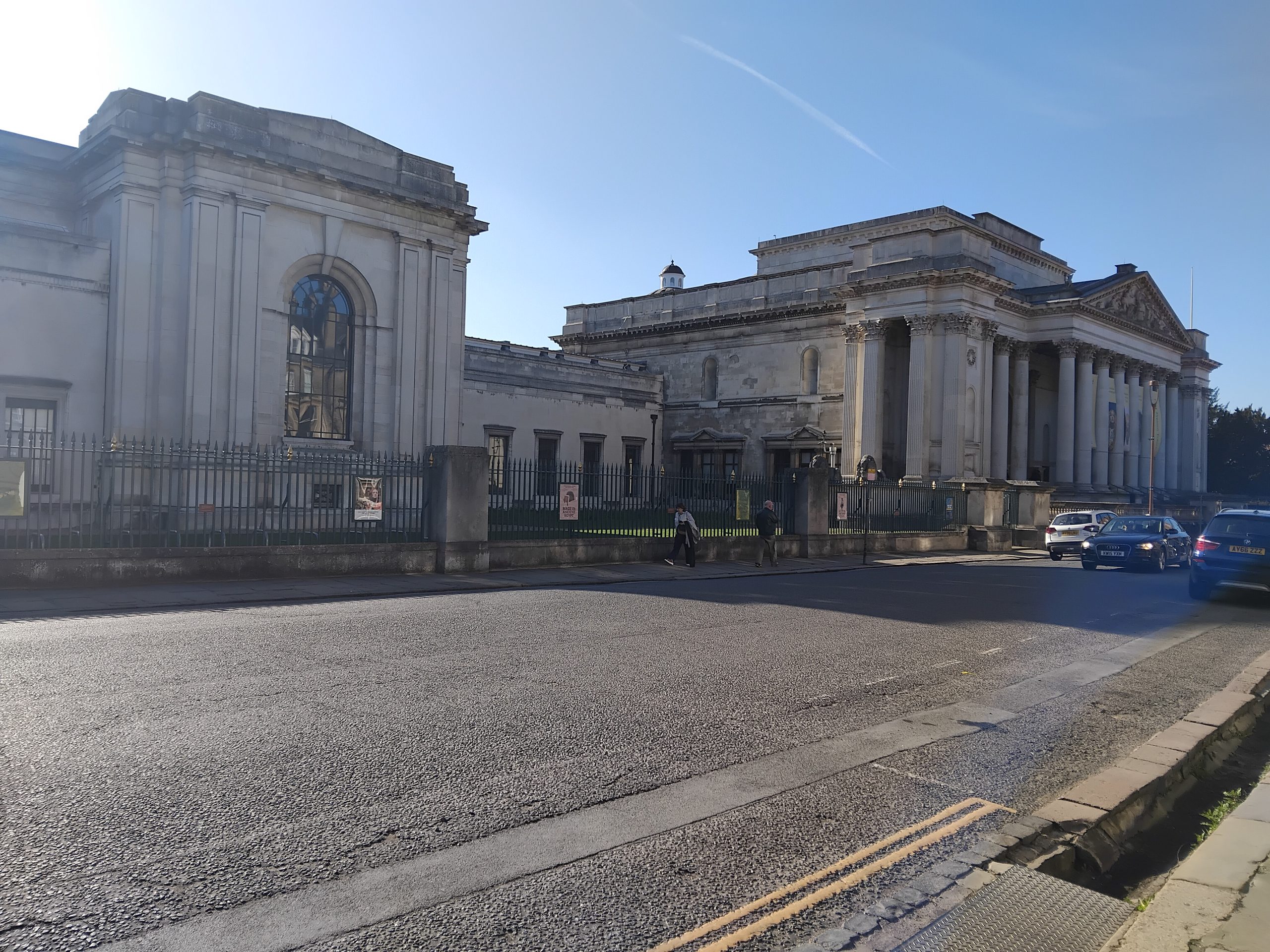
In many ways, the Fitzwilliam Museum is comparable with the Ashmolean Museum and also houses a world-renowned impressive collection, including biblically significant archaeological artefacts. Both serve their respective universities and have majestic architecture to enhance the visiting experience and admission is free. The Fitzwilliam Museum is situated just over a mile from Cambridge train station and in addition, there are Park and Ride options.
At their temporary Ancient Egyptian Exhibition, I particularly enjoyed viewing the Tuthmosis III Shrine (the Pharaoh of the Exodus assuming an early date which I hold to) and seeing the head and statue of Senworset III (most likely the Pharaoh whom Joseph would have served whilst he was Prime Minister). Here then is a guided tour of the biblical artefacts in Rooms 19, 20, 23 and 21. There are online 360 photos of some galleries https://fitzmuseum.cam.ac.uk/plan-your-visit/galleries/gallery-19 . Named Bible characters that feature in the Fitzwilliam Museum are set in bold text.
The next article will focus on items that are not on display. Like many other museums containing vast collections, it is not logistically possible to showcase everything!
Room 19 Egypt
Immediately on entering Room 19 on the right, there is a limestone Relief of Rameses II, who some holding to the older date would say was the Pharaoh of the Exodus. The cartouches (name rings) are prominently visible. The information board helpfully explains that the figures at the bottom can be identified as Libyans, who were traditional enemies by the feathers they wear.
Later on in Egypt’s history, the 22nd and 23rd Dynasties were both Libyan Dynasties.[i] The first king of the 22nd Dynasty was Sheshonk I (this is the biblical Shishak mentioned in 1 Kings 11:40; 14:25-26; 2 Chronicles 12:2-9)[ii] and the last king of the 23rd Dynasty was Osorkon IV (this is So, King of Egypt referred to in 2 Kings 17:4).[iii]
If you proceed through the open doorway towards the other end of the room on the left side there is a glass case with a limestone door jam formerly from a tomb and re-used in the palace of Apries. Again a cartouche towards the top is easily visible. Apries is the Hophra mentioned by name in Jeremiah 44:30 who the Lord would give into the hand of his enemies and is referred to in Ezekiel 29:2 and Jeremiah 37:5-10 by his title ‘Pharaoh’.
In the immediate next case there is a cartonnage mummy case that belonged to an officer called ‘Hor’ who was a prophet of Amun. Amun is the false god mentioned in Jeremiah 46:25 whom the Lord would judge along with Pharoah and Egypt and those who trust in them and would deliver them into the hand of Nebuchadnezzar. Amun is often depicted as a ram and appears often alongside Pharaoh Taharqa and there are many statues of Amun in prominent museums and in Egypt.
The display board explains that the case can be dated through some of the titles to the reign of Sheshonk I, who ruled in the 22nd Dynasty (Libyan Dynasty). However, Hor’s burial was found in the earlier funerary temple of Rameses II. Sheshonk I (Shishak) is of importance biblically since Solomon sought to kill Jeroboam, so he arose and fled to Shishak king of Egypt until the death of Solomon (1 Kings 11:40). Later in the fifth year of King Rehoboam, Shishak came up against Jerusalem and took away many treasures of the house of the Lord (1 Kings 14:25-26; cf. 2 Chronicles 12:2-9).
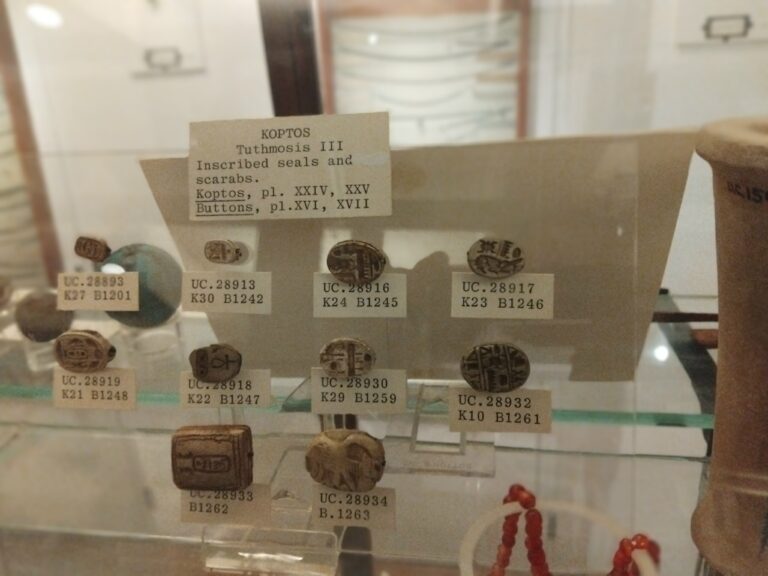
At the back wall of Room 19, there are several items relating to Tuthmosis III (Pharoah of the oppression and also probably the Exodus assuming an early date, although Amenhotep II is also a strong candidate for the Pharaoh of the Exodus) including a limestone shabti figure belonging to him, calcite jars, a limestone statue of a seated-pair Karema and his wife Abykhy. Karema was actually a doorkeeper at the temple of Tuthmosis III at Thebes. There are also glazed scarabs and oval plaques from a man’s tomb, one of which contains the name of Tuthmosis III.
Room 20 Egypt
If you enter Room 20 from the Room 19 entrance, on the immediate left, there are four objects placed together inside a glass case relating to King Taharqa (2 Kings 19:9; Isaiah 37:9). He is the King of Ethiopia mentioned in those two references above and also the fourth Pharaoh of the 25th (Kushite) Dynasty.[iv]Taharqa aided Hezekiah when Sennacherib came up against Jerusalem but Sennacherib was unsuccessful. It is also definitely worth seeing the colossal shrine of Taharqa in the Ashmolean Museum. So in Room 20, there is a calcite shabti figure for Taharqa, a copper alloy figurine probably representing Taharqa, another copper alloy figurine and a clay funerary cone with the name of King Taharqa.
Although Room 20 relates to Egypt we also find important objects that relate to biblical characters from other empires. When another kingdom conquered Egypt, they would assume the additional title of Pharaoh and also commonly worship their gods. Until now we have mentioned the Libyan Egyptian Dynasties 22 and 23 and the Kushite Dynasty 25. During the Macedonian Period (332-305BC), Egypt was incorporated into the empire of Alexander the Great.[v] Hence in the next case on the left there is a silver coin showing the head of Alexander the Great. Daniel foretold that Alexander the Great would have an empire that would split into four parts (Daniel 8:5-8; cf. 21-22) and 1 Maccabees 1:1-8 provides the historical account of that.
In the next glass case, there are a number of artefacts relating to Roman emperors, some of which are named in the Bible and others of importance concerning biblical and Jewish history. There is a glazed ceramic portrait of Tiberius (Luke 3:1), a limestone stela of Nero (the unnamed Caesar of Acts 25-26 and 28:19) and a meta-basalt statue of Vespasian, whose elder son Titus destroyed the temple in Jerusalem in AD70. Then there is a sandstone temple relief of Domitian making an offering to Amun-Ra in the form of a ram. Again, the Ram of Amun is easily recognisable. Domitian was the emperor whilst John was on the Isle of Patmos and it is interesting to note that whilst there was pressure to confess Caesar as Lord or God, though he himself worshipped the Egyptian god!
There is also a silver coin of Augustus (Luke 2:1) regarding the capture of Egypt, a tetradrachm coin with the bust of Alexandria and Nero is pictured on the other side, a coin relating to the Alexandrian temple of Julius Caesar and a coin pertaining to an Egyptian temple of Hadrian. Sadly, Hadrian was deeply antisemitic, forbade circumcision, suppressed the second Jewish revolt and renamed Judea ‘Syria Palestine’. Hadrian’s wall stretching some 73 miles serving the northern frontier remains today.
Turning our attention to the back wall to the glass case on the left, there are a couple of granite head statues of Senusret III. The information board comments that it is thought that his features were purposefully aged to portray the difficulties faced by the king during this period. Only part of his face remains and there are other statues of him which can be viewed in the British Museum and Louvre Museum where he is more easily recognisable because of his prominent ears. Some say this could relate to listening to the needs of the people. Of biblical significance is that his reign fits the timeframe when Joseph would have been Prime Minister serving under Pharoah (Genesis 40:40-41). Although the exact dating of the earlier chronologies of specific pharaohs varies, 1 Kings 6:1 and Exodus 12:40-41 give us a date for the settlement of Jacob and family settling in Egypt in 1876.
Facing the back wall in the glass case on the right there is a limestone relief with a cartouche from Deir Al Bahri, West wall of the chapel of Tuthmosis I, a limestone relief representing Tuthmosis III from Deir Al Bahri, the funerary temple of Hatshepsut, a limestone relief of a Sphinx wearing the royal regalia probably representing Hatshepsut and a limestone relief of the mother of Hatshepsut, Ahmose Nefertari. The sphinx presents the idea of identifying the pharaoh with divinity by showing the head of the ruler with the body of a lion. Hatshepsut was the elder daughter of Tuthmosis I[vi] (who was probably the pharaoh giving the order to kill the Hebrew boys). She was also married to her half-brother Tuthmosis II[vii] (who probably was the Pharaoh whom Moses fled from) and she was co-regent with Tuthmosis III (who was most likely the Pharoah of the Exodus assuming the early date).
Other items in this case include another limestone relief with a cartouche of Tuthmosis III, a silver ring of Tuthmosis III, a glazed ceramic inlay of Tuthmosis III, a limestone stela where Tuthmosis III offers to Sesostris I and a granite obelisk of Tuthmosis III. The multiple mentions of Tuthmosis III and Hatshepsut illustrate how well attested they are in museums as well as in Egypt.
Moving along to the next case on the right there are numerous objects relating to the Amarna Royal family from the 18th Dynasty especially Akhenaten and Nefertiti who are quite distinguishable by their stylised appearance of that era. Akhenaten moved the capital of Egypt from Thebes to Akhenaten (modern day Amarna) and worshiped Aten the sun god alone and rejected polytheism. More of the same can be seen further up along that wall. This important episode in Egyptian history took place after Tuthmosis III but also before the 19th Dynasty and Rameses the Great. In the next case, on the front wall there are a variety of exhibits relating to the Ramesside Period.
Room 23 Ancient Near East
Room 23 can be accessed via several rooms including rooms 21 or 19. A real highlight was viewing the cylinder of Neriglissar (Nergal-Sarezer of Jeremiah 39:3, 13) since I cannot recall seeing anything directly relating to him in other museums I have visited with significant collections of biblical artefacts! Neriglissar served as an important official in the court of Nebuchadnezzar before he became the fourth king of the Neo-Babylonian Empire c. 560-556 BC.[viii]
In the same case, there is a large-stamped brick of Nebuchadnezzar II with cuneiform script (cf. Daniel 1-4 and other references). Under item 42 in the same glass case as the other items mentioned in this room, there is an alphabetical list of cuneiform tablets. The one labelled (O) relates to a list of fleeces of different colours for the revenue of the Temple of Bel in Babylon, in year 2 of the reign of Nebuchadnezzar II. The one labelled (Q) pertains to an account of barley growing with the names of the witnesses in year 10 of Darius I (cf. Haggai 1:1; Zechariah 1:1). Another one designated (R) is a private letter from year 9 of Nabonidus. Nabonidus was the father and co-regent of Belshazzar which affords us valuable insight to understand why Belshazzar appointed Daniel as the third ruler in the kingdom in Daniel 5:29.
Room 21 Greece & Rome
In the centre of Room 21 there is a head statue of Julius Caesar and next to that a head statute of Livia who was the wife of Augustus the first emperor of Rome. Then behind a column one can view a fragmentary Greek inscription dedicated to the Emperor Nero from the inhabitants of one of the Greek cities in the Fayoum district of Egypt. The information board states that he is praised as ‘saviour and benefactor of the inhabited world’ intended to ensure good relations between the Greeks of Egypt and their Roman rulers. This brings home the reality of living in an era when Nero was emperor and the extent of his power and egocentricity.
In the glass case behind there is a silver denarius of Brutus which names the Ides of March and recalls the daggers used to murder Julius Caesar. Augustus Caesar then reigned after Julius Caesar. There are also a bronze head of Caligula and a brass sestertius of Caligula sacrificing at the temple of Augustus, although when I visited the sestertius was not displayed at the time. Caligula reigned for three years and ten months between Tiberius and Claudius. He honoured his father’s memory by renaming the month of September, ‘Germanicus’. Finally there is a drachma coin which may portray Germanicus which was issued by Claudius Caesar (Acts 11:28; 18:2). On the reverse of the coin Claudius is in a chariot with the words ‘DE BRITANNIS’ clearly marked. Those objects above illustrate how the Caesars mentioned by the classical writers and authors in the New Testament overlap during Bible times and reminds us of the Roman invasion of Britain that was occurring simultaneously.
Closing thoughts
The Fitzwilliam Museum houses an essential collection of biblical artefacts relating to named biblical characters from the Egyptian, Babylonian, Persian and Roman empires. This helps us to piece together ancient history, though more importantly to recognise both the historicity and reliability of the Bible. The Bible is a book like none other since prophecy has been fulfilled in what is now history and when the history is examined it becomes increasingly evident that it is history foretold in the Bible. The Scriptures speak of the Messiah who is coming again to the Mount of Olives in Jerusalem. What really matters in life and for eternity is this; that you are ready for when Messiah comes and that you turn from your sins and are trusting in Him now.
[i] Teagan Wolter List of Pharaohs of Ancient Egypt https://www.britannica.com/topic/list-of-pharaohs-of-ancient-Egypt
[ii] Titus Kennedy Archaeology and the People of the Bible (Harvest House, Eugene, Oregon; 2026), p30
[iii] Ibid, p94
[iv] Wolter, List of Pharaohs of Egypt
[v] Ibid
[vi] Joyce Tyldesley Hatshepsut Ruler of Egypt https://www.britannica.com/biography/Hatshepsut
[vii] Ibid
[viii] Kennedy, p192