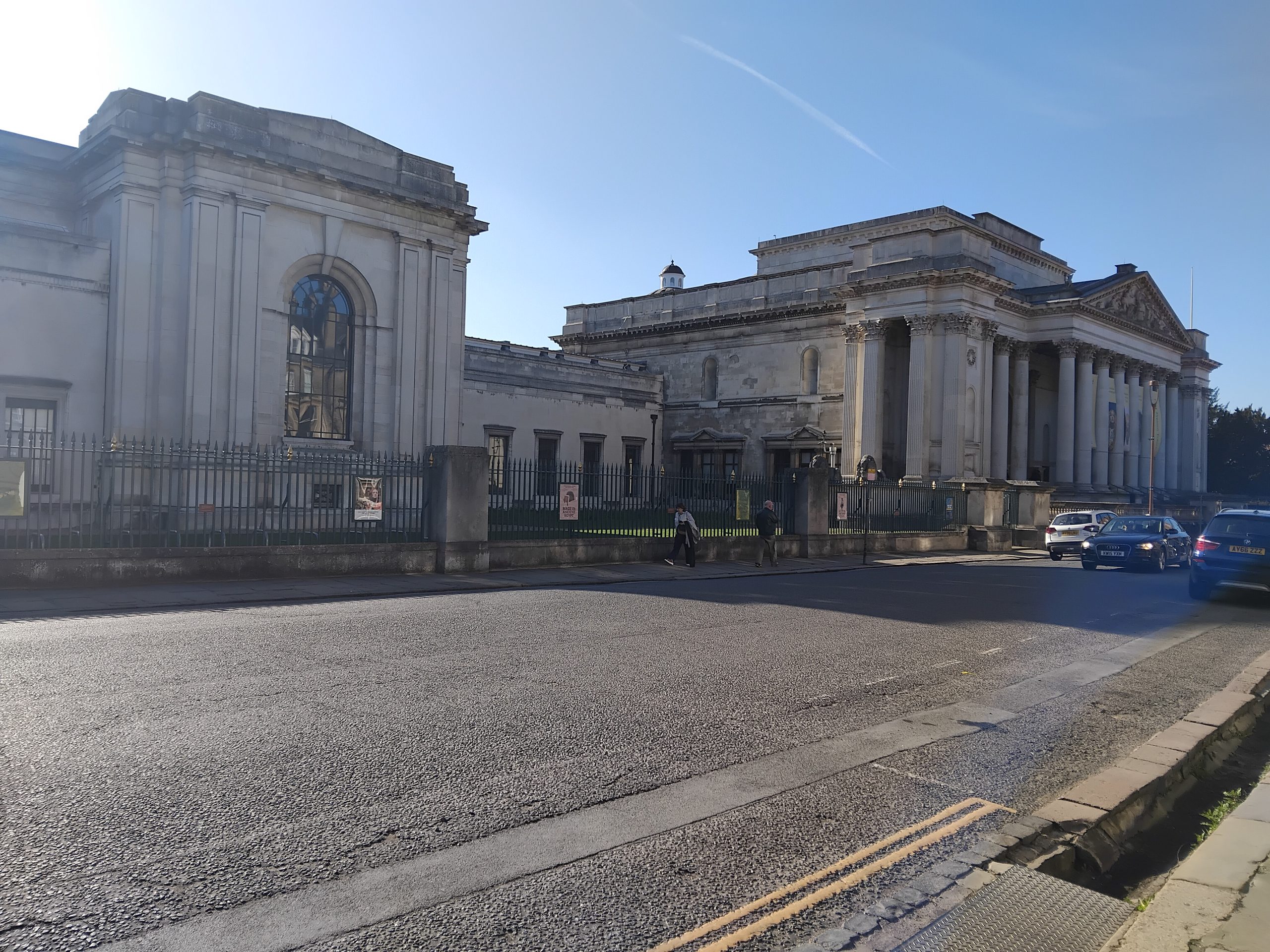
There are other biblical artefacts housed at the Fitzwilliam Museum that are not on display and this is to be expected considering the vast repository of objects contained in the entire collection. The same applies concerning the British Museum and the Ashmolean Museum. Although it is a much smaller museum, the Petrie Museum displays over 8,000 artefacts though possesses more than 80,000 items. This follow-up article will focus on some highlights of the biblically important artefacts, not currently on display that can be readily viewed via searching the Fitzwilliam Museum Collection online.
Necho II Seal (E.511.1939)[i]
This ovoid seal is inscribed with the name of Wehemibre (Necho II). The item number is on the reverse side. Necho II is mentioned in 2 Kings 23:29-35, 2 Chronicles 35:20-36:4 and Jeremiah 46:2. The reference in 2 Kings 23:29-35 relates to Pharaoh Necho II killing Josiah at Megiddo, putting King Jehoahaz in prison that he might not reign in Jerusalem and he imposed on the land a tribute of one hundred talents of silver and a talent of gold. Pharaoh Necho also made Eliakim the son of Josiah king in his place of his father Josiah and changed his name to Jehoiakim.
The reference in 2 Chronicles 35:20-36:4 explains that Necho II tried to dissuade Josiah from fighting since he desired to face Carchemish and even urged him to refrain from meddling with God. Josiah disguised himself in the battle, sadly was killed and all Judah and Jerusalem mourned for him. Interestingly this reference states that Jeremiah also mourned for Josiah. The last reference in Jeremiah 46:2 is the Lord’s pronouncement of judgement on Egypt concerning the army of Pharaoh Necho which was by the River Euphrates in Carchemish and which Nebuchadnezzar, King of Babylon defeated in the fourth year of Jehoiakim, the son of Josiah, King of Judah. Necho II is also attested in other ancient sources including Egyptian monuments, Babylonian Chronicle and Herodotus.[ii]
Darius I Inscribed tablet (ANE:37.1904)[iii]
This tablet is inscribed on both sides in cuneiform script regarding the sale of a slave woman including the price paid, a personal guarantee and is dated to the 6th day of the 12th year of Darius I. In the Scriptures, Darius I is referenced in Ezra 4:5-24; 5:5-6:15; Haggai 1:1 and Zechariah 1:1. In relation to the Ezra 4:5-24 reference our interest in Darius I relates to the first and last verse, like bookends. In Ezra 4:5 counsellors were hired to frustrate the purpose of rebuilding the city all the days of King Cyrus, even until the reign of King Darius of Persia. In between that period, a letter was written to Artaxerxes to cease the work of rebuilding. Verse 24 confirms that the work of the house of God ceased until the second year of the reign of Darius King of Persia.
In Ezra 5:5 the eye of their God was upon the elders of the Jews so their opponents could not make them cease until a report could go to Darius. In Ezra 6:1 King Darius issued a decree and a search was made concerning whether Cyrus issued a decree to build the temple in Jerusalem. A scroll was found affirming the same and the temple was completed on the third day on the month of Adar, which was in the sixth year of the reign of King Darius (Ezra 6:15).
The Haggai 1:1 reference confirms the word of the Lord came to Haggai on the first day of the sixth month in the second year of King Darius. Haggai subsequently urged the people to rebuild the temple. Then in Zechariah 1:1, in the eighth month of the second year of Darius, the word of the Lord came to Zechariah, the son of Berechiach, the son of Iddo the prophet. Darius is attested in several locations and artefacts including the Behistun inscription, Susa royal inscriptions, Persepolis Apadana, Foundation Tablets and the Tomb of Darius I[iv]
Artaxerxes I Siglos (CM.6524-2007)[v]
This tiny silver coin shows a crown on the figure of the king on the front view although the reverse is well worn. Artaxerxes is mentioned in the Scriptures in Ezra 4:7-23, 7:7-26 and Nehemiah 2:1-8. In Ezra 4:7-23 a letter was written to Artaxerxes urging him to stop the work of rebuilding Jerusalem and he granted the request. However in Ezra 7:7-26 Artaxerxes issued a decree to build the temple and to do so diligently! Ezra recognised that the Lord put this into the heart of Artaxerxes (Ezra 7:27). Proverbs 21:1 tells us that ‘The king’s heart is in the hand of the Lord, like the rivers of water; He turns it wherever He wishes.”
The reference in Nehemiah 2:1-8 shows how Artaxerxes looked upon Nehemiah’s request favourably. He noticed that Nehemiah his cupbearer was experiencing sorrow of heart so Nehemiah explained that Jerusalem was in ruins. Artaxerxes then enabled Nehemiah to travel to Jerusalem and rebuild the walls and even provided letters to permit him access through the respective territories en route. The British Museum contains the silver drinking vessels of Artaxerxes, which Nehemiah may have served him with. An inscription inside the rim of the bowl lists the names of Artaxerxes, Xerxes and Darius.
Roman coins
The Fitzwilliam Museum stores an impressive coin collection that includes several of the Caesars and other Bible characters, some of which are mentioned in the Bible and others are especially relevant to Jewish history in the first and early second century. A Roman provincial coin minted in Jerusalem whilst Augustus was Caesar (CM.1384.1963)[vi]was possibly issued by Coponius, who was the first procurator of Judea.[vii]Luke 2:1 refers to Caesar Augustus sending out the decree for all the world to be registered.
Another Roman provincial coin was also minted in Jerusalem and issued by Pontius Pilate whilst Tiberius was Caesar (CM.1386.1963)[viii]Pontius Pilate is mentioned in Matthew 27:2, Mark 15:1-44, Luke 3:1, John 18:33, Acts 4:27 and 1 Timothy 6:13. Pontius Pilate is the governor who questioned Jesus and thought He was innocent and washed his hands before Jesus was crucified. Luke 3:1 writes concerning the fifteenth year of Tiberius’ reign when the word of God came to John the son of Zacharias.
Antonius Felix issued a coin minted in Jerusalem whilst Claudius was Caesar (CM.1387.1963).[ix] Marcus Antonius Felix was the procurator of the Judean Province[x] and is mentioned in Acts 23:24-24:27 whom the Apostle Paul gave a defence to. Claudius Caesar is named in Acts 11:28 and 18:2 regarding firstly the worldwide famine that would occur during his reign and with reference to Acquila and Priscilla coming to Corinth from Italy since Claudius had commanded all the Jews to depart from Rome.
A sestertius coin replica with the head portrait of Nero and ‘NERO CAESAR’ clearly visible, (CM.3155-2003)[xi]does not contain the issuer. Nero was the unnamed Caesar who Paul sought to appeal to and is referenced in Acts 25-26 and 28:11.
A Roman Imperial sestertius copper alloy coin with the head of Vespasian and the name ‘Caesar Vespasian’ (CM.1718-1963)[xii] is easily visible. On the reverse a Jewish woman appears to be weeping under a palm tree. This was produced in AD71 after the destruction of the temple in Jerusalem in AD70 and there is a figure standing on the other side of the palm tree. Another Roman imperial coin struck in the name of Titus relates to the father and son respective emperors Vespasian and Titus (CM.6565-2007)[xiii]. Titus was responsible for the destruction of the temple in Jerusalem in AD70.
Lastly, there is a Roman Provincial coin relating to Hadrian that was minted in Caesarea Maritima (CM.LS-1835-R)[xiv]. Emperor Hadrian sadly forbade circumcision, suppressed the second Jewish revolt and renamed Judea ‘Syria Palestine’.
The Herodian Family
The Fitzwilliam Museum houses an especially fine collection of coins from the Herodian family. All the ones here are mentioned in the Bible and are also attested in Josephus. I have provided the dates for the respective Herodian family members since they are notoriously easy to confuse with each other!
A coin, minted in Jerusalem whilst Herod the Great (37-4BC) was ruler (CM.1380-1963)[xv] is somewhat battered but has survived. This is the Herod of Matthew 2 who ordered all the male children who were two years old and under in Bethlehem and all its districts to be killed.
Another obviously well-worn coin with an illustration of an anchor on the front relates to Herod Archelaus (4BC-6BC)[xvi](CM.LS.1871-R).[xvii]It is inferred that it was minted in Jerusalem. Herod Archaeleus is named in Matthew 2:22 as reigning over Judea and being warned by God in a dream, Joseph turned and went to Galilee with Jesus and Mary.
A Roman provincial coin was minted in the reign of Tiberius and Herod Antipas (4BC-39AD) (CM.LS.1880R)[xviii]This is Herod the Tetrarch and he is mentioned in Matthew 14:1-6; Mark 6:14-22; Luke 3:1; 19-20; 23:7-15 and Acts 13:1[xix] in connection with when John the Baptist was beheaded, questioning Jesus before He was crucified and specifically as Herod the Tetrarch of Galilee.
Another faded coin was minted in Caesarea Philippi in the reign of Tiberius and Herod Philip II (AD14-37) (CM.LS.1881-R)[xx]This is Philip the Tetrarch of Luke 3:1. There is a portrait of a head on the front. Philip did not have to be too concerned about portraits since his subjects were mainly not Jewish and had no religious prohibition against graven images.[xxi]
The last coin relates to Herod Agrippa I (AD41-44) (CM.524-1950)[xxii]This is Marcus Julius Agrippa and he is mentioned in Acts 12:1-23 as harassing the church and who himself suffered a violent death. The people kept shouting ‘the voice of a god’ and since he did not give glory to God he was eaten by worms and died. Josephus recalls a similar though more graphic account of his death![xxiii]
Closing Thoughts
Due to the size of the collection in the Fitzwilliam Museum and other major museums, it is important to recognise that there are many biblical artefacts and items of Jewish relevance housed in museums not on display. The Fitzwilliam museum has an impressive collection on display and in addition, numerous items that are not currently publicly exhibited! All the above convincingly demonstrates strong historical attestation of biblical characters and even events. This is strengthened yet further when there is more than one biblical character archaeologically confirmed, who also cross paths with each other, either through battle such as Necho II and Nebuchadnezzar II or coinage such as Pontius Pilate and Tiberius Caesar.
[i] The Fitzwilliam Museum (2026) “Seal” Web page available at: https://data.fitzmuseum.cam.ac.uk/id/object/54221 Accessed: 2026-03-23 16:19:56
[ii] Titus Kennedy Archaeology and the People of the Bible (Harvest House, 2026; Eugene, Oregon), p160
[iii] The Fitzwilliam Museum (2026) “” Web page available at: https://data.fitzmuseum.cam.ac.uk/id/image/media-59114 Accessed: 2026-03-23 16:54:14
[iv] Kennedy, p212
[v] The Fitzwilliam Museum (2026) “” Web page available at: https://data.fitzmuseum.cam.ac.uk/id/image/media-145828 Accessed: 2026-03-23 17:22:53
[vi] The Fitzwilliam Museum (2026) “Roman Provincial” Web page available at: https://data.fitzmuseum.cam.ac.uk/id/object/225516 Accessed: 2026-03-23 18:58:42
[vii] Richard Gotthiel, Samuel Krauss Coponius https://www.jewishencyclopedia.com/articles/4641-coponius
[viii] The Fitzwilliam Museum (2026) “Roman Provincial” Web page available at: https://data.fitzmuseum.cam.ac.uk/id/object/225518 Accessed: 2026-03-23 19:10:28
[ix] The Fitzwilliam Museum (2026) “Roman Provincial” Web page available at: https://data.fitzmuseum.cam.ac.uk/id/object/225520 Accessed: 2026-03-23 19:22:17
[x] Kennedy, p324
[xi] The Fitzwilliam Museum (2026) “Sestertius” Web page available at: https://data.fitzmuseum.cam.ac.uk/id/object/159182 Accessed: 2026-03-23 19:34:41
[xii] The Fitzwilliam Museum (2026) “Sestertius of Vespasian, obverse” Web page available at: https://data.fitzmuseum.cam.ac.uk/id/image/media-905349948 Accessed: 2026-03-23 19:40:26
[xiii] The Fitzwilliam Museum (2026) “” Web page available at: https://data.fitzmuseum.cam.ac.uk/id/image/media-145911 Accessed: 2026-03-23 19:51:18
[xiv] The Fitzwilliam Museum (2026) “Roman Provincial” Web page available at: https://data.fitzmuseum.cam.ac.uk/id/object/175751 Accessed: 2026-03-23 19:55:30
[xv] The Fitzwilliam Museum (2026) “” Web page available at: https://data.fitzmuseum.cam.ac.uk/id/image/media-211432 Accessed: 2026-03-23 20:09:40
[xvi] Lawrence Mykytiuk February 9th, 2025, 30 People in the New Testament Confirmed https://www.biblicalarchaeology.org/daily/people-cultures-in-the-bible/people-in-the-bible/new-testament-political-figures-the-evidence/
[xvii] The Fitzwilliam Museum (2026) “Roman Provincial” Web page available at: https://data.fitzmuseum.cam.ac.uk/id/object/175787 Accessed: 2026-03-23 20:22:10
[xviii] The Fitzwilliam Museum (2026) “Roman Provincial” Web page available at: https://data.fitzmuseum.cam.ac.uk/id/object/175796 Accessed: 2026-03-23 20:33:12
[xix] Kennedy,p270
[xx] The Fitzwilliam Museum (2026) “Roman Provincial” Web page available at: https://data.fitzmuseum.cam.ac.uk/id/object/175797 Accessed: 2026-03-23 20:50:34
[xxi] Mykytiuk, 18. Philip, Tetrarch https://www.biblicalarchaeology.org/daily/people-cultures-in-the-bible/people-in-the-bible/new-testament-political-figures-the-evidence/#note11
[xxii] The Fitzwilliam Museum (2026) “Judaea” Web page available at: https://data.fitzmuseum.cam.ac.uk/id/object/225514 Accessed: 2026-03-23 20:58:40
[xxiii] The New Complete Works of Josephus Translated by William Whiston Commentary by Paul Maier (Kregel, Grand Rapids; 1999), Jewish Antiquities, Book 17, Chapter 6, 5 (p 565)