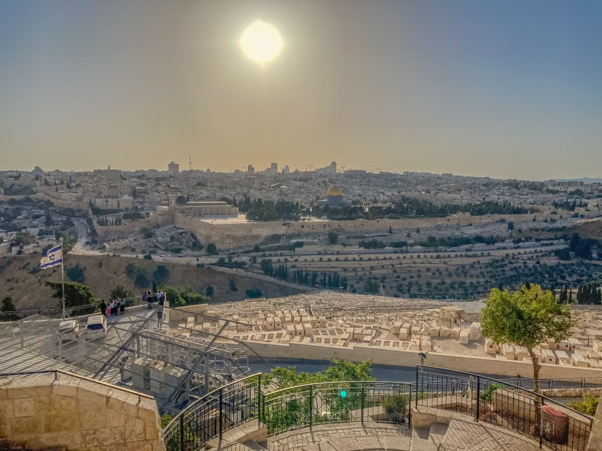
This is the culminating Song of Ascents that draws heavily from other Songs of Ascent and psalms and is intensely focussed on worshipping the Lord in the temple in Jerusalem at night. The priests and Levites were chosen by the Lord for this particular and privileged task, initially to bear the ark of the covenant and also to stand before Him, minister to Him, thank Him and praise Him, morning and evening and to bless His name and to burn incense (Deuteronomy 10:8; 18:7; 1 Chronicles 23:30; 2 Chronicles 29:11; 35:5; Leviticus 8:33).
How can we serve and praise the Lord at night?
David wrote the preceding psalm and the opening verse of Psalm 134 closely parallels Psalm 135:1-2. Gill thinks it was written by David.[i] Concerning worshipping the Lord at night, David stated in Psalm 119:62, “At midnight I will rise to give thanks to You, because of Your righteous judgements.” Psalm 130:6 reads, “My soul waits for the Lord more than those who watch for the morning-yes, more than those who watch for the morning.” Psalm 132:4-5 is connected from the outset with the Davidic Covenant and the desire of the psalmist is, “I will not give sleep to my eyes or slumber to my eyelids, until I find a place for the Lord, a dwelling place for the Mighty One of Jacob.”
We intentionally stay up at night only for the things that we consider to be of great importance. People that work in hospitals undertake nightshifts or perform vital operations during the dark hours. Some people require care, day and night and others are devoted in caring for them. To make a living some will work nightshifts, most likely weighing the benefits and costs of labouring during unearthly hours. Sporting enthusiasts may stay up to view a significant event whilst it is televised live and the images are being relayed from a different part of the globe functioning on another time zone. Here however, it is a special honour to minister to the Lord whilst the majority of the immediate population are fast asleep. It also asks a question of us, in that sleep is obviously of great importance, yet of how much greater importance, is a constant life of prayer unto the Lord?
The great hymn, ‘The Day Thou gavest Lord is ended’ reminds us that whilst we inevitably fall asleep, many across the continents and islands continue to praise the Lord. The praise of the Lord is continuous; it never ceases and from the rising of the sun to the going down of the same, the Lord’s name is to be praised. Hence, when we praise the Lord, we are part of a continual service of praise unto the Lord.
In the Lord’s plans and purposes for Israel and the nations, there is more in view concerning the temple and Jerusalem and Messiah, yet future. Williams writes that, “It is a scene of millennial peace and glory. Messiah as Creator of the heavens and of the earth, is enthroned in Zion (v.3), and from thence, as a source, blessing flows forth. Men will then lift their eyes to Zion (v.2) and from thence expect the supply of all their needs.”[ii]Unger astutely observes that this psalm appears to indicate that the services were held for several nights in succession, apparently during the Feast of Tabernacles and that prophetically, this scene looks ahead to Messianic Age, when the antitype of that Feast will be realized.[iii](cf. Zechariah 14:16-21)
There will come a day when the Lord’s house will be a house of prayer, for all nations and the Lord will gather many to Him (Isaiah 56:7-8). There is an assurance of these things in Isaiah 62:7-8, which reminds us to be both aware and praying into this. “I have set watchmen on your walls, O Jerusalem; they shall never hold their peace day or night. You who make mention of the Lord, do not keep silent, and give Him no rest till He establishes and till He makes Jerusalem a praise in the earth.”
Remember this is a Song of Ascents, so let us consider the role of the servants, ministering at night in the temple. Gill, who so frequently gleaned insight from the great Jewish interpreters, noted that Kimchi thought that the servants related to the great and holy men who rose from their beds at night and went to pray in the temple and Gill compares that view with Anna in Luke 2:37; also that Rabbi Obadiah and Arama, that these were those who studied the law an expositions of it at nighttime, but it is generally accepted that it referred to the priests and Levites who served at night.[iv] Malbim, stated, “The servant of Hashem never abandons his position; even in “nights” of adversity and gloom, he remains at his post.”[v]Thus, if there are necessary earthly commitments to attend to, how much more should we stand for and serve the Lord in the dark episodes of life and be faithful in His service?
The priests and Levites would have ensured that the temple was safe and sanctified[vi] and that everything was prepared for the following day concerning the wine, oil, frankincense and shewbread[vii] and singing and praise, would continue throughout the night. In a most reassuring way, Wiersbe helps us understand the Lord’s providential care for us at night. “When we go to sleep, we know that the Father is caring for us, and when we awaken, He is there to greet us (91:1-16). If we awaken in the night, we can fellowship with Him and meditate on His Word (119:115, 62, 148-157). If God never slumbers nor sleeps, why should we stay awake all night, tossing and turning and fretting? “Be still and now that I am God” (Psalm 46:10).”[viii]
How can we lift up our hands?
The servants of the Lord lifted their hands to praise and worship the Lord in the sanctuary at night. David prays in Psalm 28:2 that the Lord would hear his prayers when he prays towards His holy Sanctuary. In Psalm 63:2-4, it is again David that looked for the Lord in the Sanctuary and praised, blessed and lifted his hands up to His name. Paul wrote to Timothy in 1 Timothy 2:8 desiring that the men would pray everywhere lifting up holy hands, without wrath and doubting. God desires heartfelt and pure worship from sanctified worshippers.
Thinking about praising the Lord at night as well as the day, helps us to consider further how we can more effectively praise the Lord at all times, situations and locations. Matthew Henry wrote, “It is an excellent plan to fill up all our spare minutes with pious meditations, and prayers and praises. No time would then be a burden, nor should we murder our hours by trifling conversation and vain amusements, or by carnal indulgences. We need desire no more to make us happy, than to be blessed of the Lord. We ought to beg spiritual blessings, not only for ourselves, but for others; not only, The Lord bless me, but The Lord bless Thee; thus testifying our belief that there is enough for others as well as for us, and showing our good will to others.”[ix]
How does the Lord bless us?
In the closing verse in this final Song of Ascent, the reference to the Lord who made heaven and earth recalls to us that help comes from the One who made heaven and earth (Psalm 121:1-2), whose help is in the name of the Lord who made heaven and earth (Psalm 124:8). Messiah is both Creator and Saviour and He is the One who made atonement for our sin and whom we must trust in for salvation! Jesus left from the Mount of Olives and that is where He will return. The blessing is from Zion and on this last occasion it is the Lord who blessed His people. In Psalm 128:5, the psalmist prayed, “The Lord bless you out of Zion, and may you see the good of Jerusalem, all the days of your life, Yes, may you see your children’s children. Peace be upon Israel!”
This psalm fittingly closes with the Lord blessing His people which surely draws our attention to the Aaronic blessing contained in Numbers 6:24-26. The bookends of this psalm correspond with the opening and closing verses of the following psalm, “Blessed be the Lord out of Zion, who dwells in Jerusalem! Praise the Lord!” (Psalm 135:21) So the Lord blesses His people in Zion, the setting of the feasts and the Songs of Ascent and also the setting of the setting of Messiah’s future Messianic Kingdom! Are you trusting in Messiah and are you prepared for His return?
[i] John Gill Gill’s Exposition of the Whole Bible https://www.studylight.org/commentaries/eng/geb/psalms-134.html
[ii] George Williams Williams’ Complete Bible Commentary (Kregel, 1994; Grand Rapids), p406
[iii] Merrill F. Unger Unger’s Bible Commentary (AMG, 2002; Chattanooga), p957
[iv] Gill on Psalm 134
[v] Malbim, cited in The Stone Edition Tanakh Edited by Rabbi Nosson Sherman (Mesorah Publications Ltd., 2000; Brooklyn), p1554
[vi] Warren W Wiersbe The Wiersbe Bible Commentary The Complete Old Testament in one volume (David C. Cook, 2007; Colorado Springs), p1035
[vii] Psalms What the Bible Teaches J. Flanigan General Editor W.S. Stevely (John Ritchie Ltd, 2001; Kilmarnock), p576
[viii] Wiersbe, p1035
[ix] Matthew Henry Matthew Henry Concise Commentary on the Whole Bible (Mood Press, Chicago), p452


