Much discussion has arisen both in the archaeological world and popular media regarding the Tuthmosis II Tomb discovery; apparently the greatest Egyptian finding since Howard Carter’s Tutankhamen discovery in 1922, though this recent excavation is also of biblical importance.
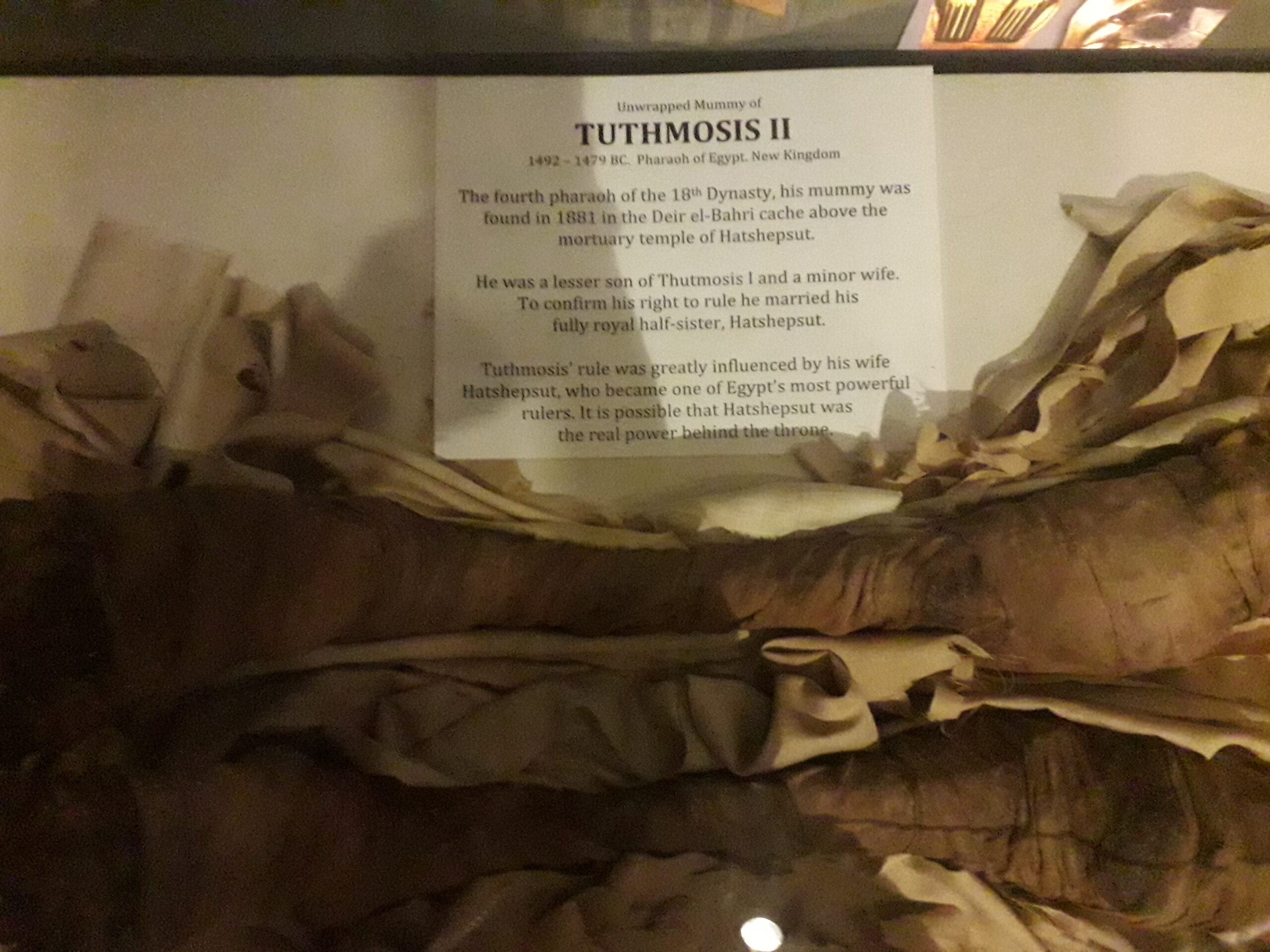
I remember enjoying a primary school project concerning ancient Egypt, clumsily drawing the Tutankhamen gold death mask and being excited to learn about the Tutankhamen discovery and wishing I had been around to see the Tutankhamen exhibition in London, 1972. Nonetheless, the Tutankhamen exhibition in Dorchester arose around the time whilst I was daydreaming during that project, which provided a recreation of replica objects linking the past with the present. In that same museum in Dorchester, which I visited last year, one can still view a replica of the unwrapped mummy of Tuthmosis II (see the photo accompanying this article). Another item of biblical interest, in the Tutankhamen Museum is labelled, ‘The Golden Cow’ which is a striking visual reminder of the Golden Calf in Exodus 32!
Interestingly the tomb of Tuthmosis II is not that far, neither in proximity, nor chronology, from Tutankhamen’s tomb and both pharaohs fall within the 18th dynasty. Please note that Egyptologists and archaeologists differ to a small degree on exact dates for an Egyptian chronology and a precise chronology is just not possible. Nevertheless, Tuthmosis II reign was from 1497BC-1492BC and Tutankhamen ruled from 1336BC-1327BC. Also, please bear with the typical use of variant spellings used for the respective pharaohs.
Tuthmosis II and the Bible
There is ongoing debate in the world of biblical archaeology regarding the early date or the late date for the Exodus. Those who favour the late date point towards Exodus 1:11 in that the children of Israel were forced to build for Pharaoh the supply cities Pithom and Raamses. Thus, the assumption is that Ramases II (1279BC-1213BC) who is clearly a famous and archaeologically attested Pharoah was the Pharaoh of the Exodus. Liberals and higher critics generally favour this date and if one watches a biblical Hollywood epic, expect to see the Pharoah of the Exodus referred to as Ramases.
Nonetheless, Genesis 47:11 tells us that Joseph provided his father and brothers a possession in the best part of Egypt in the land of Rameses. Note also that Ramses I, reigned briefly from 1292BC-1291BC. Jacob and sons settling in Egypt was obviously way before Ramases I or Ramases II which occurred during the 12th dynasty. Anderson and Edwards state that Sesostris II (1880BC-1874BC) would have been the pharaoh when Jacob settled in Egypt and Sesostris III (1874BC-1855BC) would probably have been the Pharaoh whilst Joseph was Prime Minister in his reign and Jacob died.[i]
Yet more importantly, 1 Kings 6:1, confirms that in the fourth year of King Solomon’s reign, it was 480 years after the Exodus which gives us a date of 1446BC for the Exodus. Moreover, this fits with the biblical timeframe in that in Judges 11:26, Israel dwelt in Heshbon and its villages, and in all the cities of the banks of the Arnon for 300 years (Numbers 21:25-25; Deuteronomy 2:36). Furthermore, if we consider the name ‘Moses’ (which was given to him by Pharaoh’s daughter) this reflects the similarity of the names of the pharaohs in the 18th dynasty such as Ahmose I, Tuthmosis I, Tuthmosis II, Tuthmosis III and Tuthmosis IV.[ii] None of the pharaohs in the 19th Dynasty that followed and to which Ramases I and Ramases II belonged, contained pharaohs with Mose/Mosis in their names.
Although I strongly hold to the earlier date for the Exodus, there is a vast amount of archaeological evidence to support the historicity of both Tuthmosis III and Ramases II. Examples include the Valley of the Kings in Egypt and museums such as the British Museum and the Louvre. An additional comparison is that in London, Cleopatra’s Needle was actually erected in Tuthmosis III honour, whereas in Paris the Place de la Concorde was built in Ramases II recognition.
So where does Tuthmosis II fit in with regard to the list of Pharaohs in the 18th dynasty and the children of Israel in relation to the Exodus? Edwards and Anderson state that either Ahmose or Amenophis I were responsible for the death of the Hebrew boys in Exodus 1:15-16.[iii]Tuthmosis I was the father of Tuthmosis II. Tuthmosis II is probably most famous for being the husband and half-brother of Hatshepsut and father of Tuthmosis III. Considering the biblical timeline, Anderson and Edwards state that Tuthmosis II was the pharaoh when Moses fled from Egypt (Exodus 2:15).
Although there is other evidence for Tuthmosis II in another site in Egypt, plus distinct items relating to Tuthmosis II are kept in the British Museum, the recent discovery of Tuthmosis II tomb in the last couple of weeks is an important discovery. Inscriptions on pottery jars in the latest finding identified the pharaoh as Tuthmosis II.
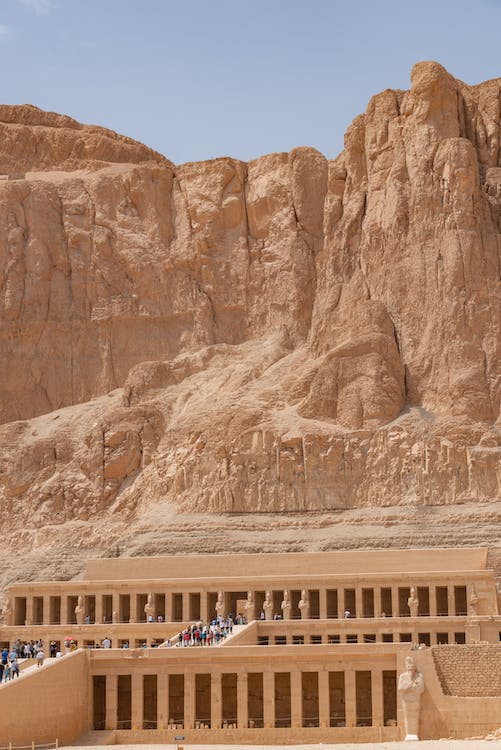
Tuthmosis II is overshadowed by his famous half-sister and wife Hatshepsut and son Tuthmosis III. In terms of biblical interest, John MacArthur states that possibly Hatshepsut or another princess was the daughter of Pharaoh in Exodus 2:5ff.[iv] One can read more about Hatshepsut in Room 4 in the British Museum and you can also view Hatshepsut’s obelisk in Room 65, in addition to other items in the Petrie Museum in London and her temple in Deir Al Bahri, Egypt.
Tuthmosis III is incredibly well attested archaeologically and Edwards and Anderson state that either Tuthmosis III was the Pharaoh of the oppression and/or Exodus, or Amenophis III/Amenhotep III with whom he co-ruled in part co-regency, was the Pharaoh of the Exodus.
One more thing…
All the above is most interesting, exhilarating and even a pleasant diversion from every-day life. Consider the number of tourists that avidly explore the Valley of the Kings and the vast numbers passing through the British Museum and the Louvre daily, many artefacts of which relate to the above mentioned and can be viewed bringing an ancient era to life. The Bible is a unique book in many ways, one of which is the remarkable historical and archaeological attestation concerning biblical characters, locations and events.
The most important thing is that we are trusting in the Lord of history, the God of the Bible who is the Creator of the heavens and the earth. Thinking of Israel’s history and the Bible must lead us to consider the Exodus. The God of the Bible redeemed His people from slavery in Egypt and guided them to the Promised Land. Jesus the Messiah is the Great Redeemer and though His sacrificial blood paid the ransom price for our souls. Our sin is a grievous offence in the sight of a holy God and separates us from our Creator and Redeemer. One day we will meet the holy God, the Judge of the whole earth whom Abraham encountered and Moses met on Mount Sinai. Are you ready to meet Him? Will you plead your own righteousness which is a grave insult to the King of the Universe? Has your sin been atoned for? Have you asked the Lord for forgiveness and are you trusting in the Lord and in what He has done? Blessed are those, who trust in Him. Selah…
[i] Clive Anderson and Brian Edwards Evidence for the Bible (Day One, 2015; Leominster), p224
[ii] Teagan Walter Fact Checked by the Editors of Encyclopaedia Britanica List of Pharaohs of Ancient Egypt https://www.britannica.com/topic/list-of-pharaohs-of-ancient-Egypt
[iii] Anderson and Edwards, p224
[iv] John MacArthur The MacArthur’s Study Bible (Crossway, 2011; Wheaton, Illinois), p95