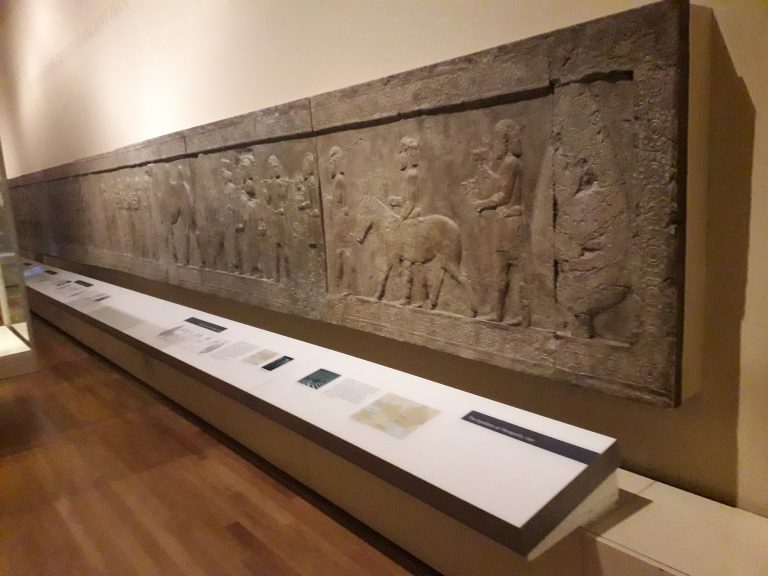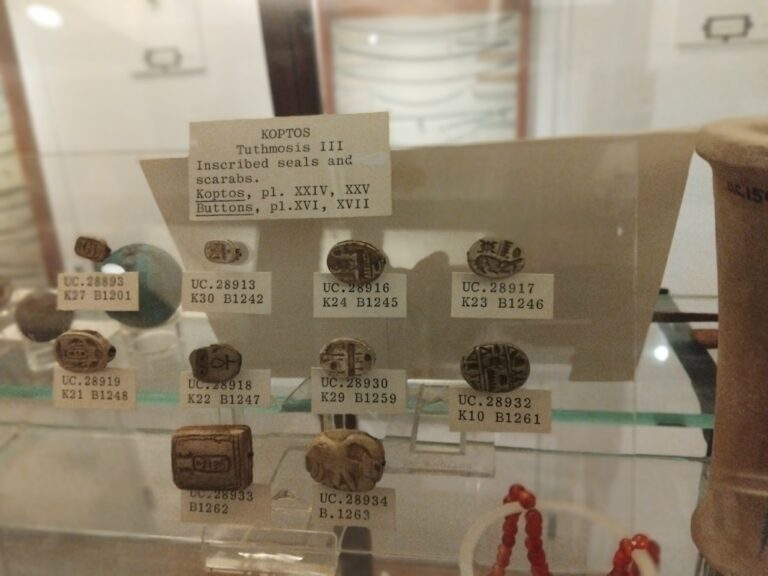
At one of my recent visits to the Bournemouth Natural Science Society & Museum, I was kindly given permission to photograph a few items of biblical archaeological interest. I am the first to admit that I am a poor photographer, though they even dimmed the lights to enable me to take a few photos. This museum is open on Tuesdays and is well worth a visit. There is much more than archaeology to view and I particularly enjoyed comparing the lion skull with the tiger one! Please check out their Facebook site and get along to the museum. https://www.facebook.com/BournemouthNaturalScienceSociety
The artefacts that are of particular interest relate to Tuthmosis III, Hatshepsut and Tarharqa. Please also allow for common variations in spelling for ancient rulers since ancient languages are being transliterated.
Tuthmosis III & Hatshepsut
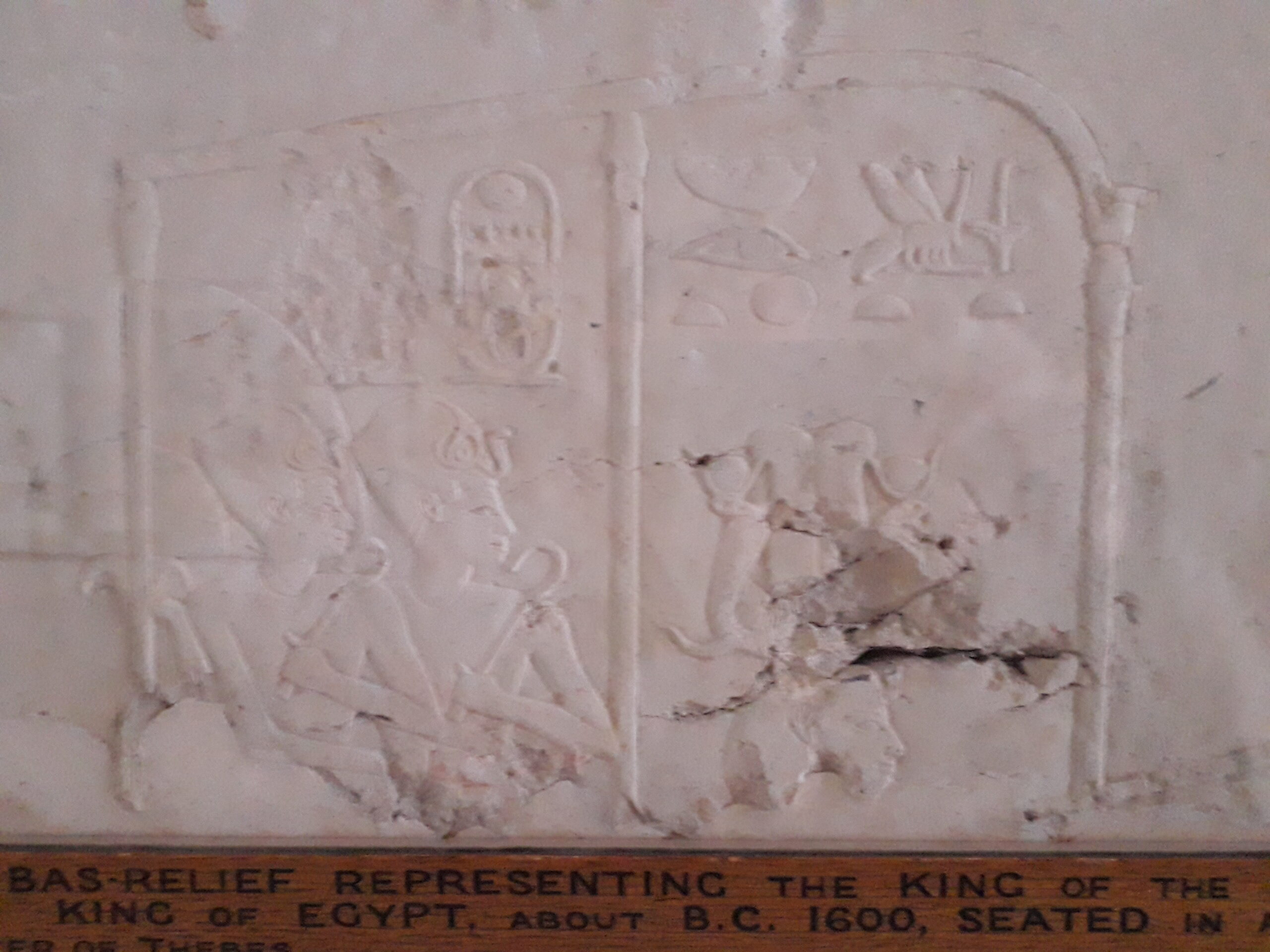
In one of the two archaeological rooms there is a bas relief pertaining to Tuthmosis III and Hatshepsut. Tuthmosis III is most likely the Pharoah of the Exodus in relation to the early date, 1446 BC which I hold to. Those who state that Ramases II was the Pharaoh of the Exodus because the children of Israel were building the store cities of Pithom and Raamses (Exodus 1:11) need to factor in that considerably earlier, Joseph situated his father and brother in the land of Egypt, in the best of the land of Rameses, as Pharaoh had commanded (Genesis 47:11).
Also, 1 Kings 6:1 confirms that the fourth year of Solomon’s reign of Israel was 480 years after the Exodus. It was Pharaoh’s daughter who named Amram and Jochebed’s son, ‘Moses’ (Exodus 2:10). Note the striking similarity between the name ‘Moses’ and ‘Tuthmosis.’ Tuthmosis III resided in the 18th dynasty, circa 1539BC-1292 BC as did Ahmose I, Tuthmose I, Tuthmose II, Tuthmose IV and Hatshepsut. However, Ramses I and Ramses II dwelt in the 19th dynasty, circa 1292BC-1191BC and Ramses III, Ramses IV, Ramses V, Ramses VI, Ramses VII, Ramses VIII, Ramses IX, Ramses X and Ramses XI all lived in the 20th dynasty, circa 1190BC-1077BC.[i]
The information board at the museum mentions that Tuthmosis III ordered that Hatshepsut’s name and images be erased. However her temple remains in Luxor, Egypt and her obelisk can be seen in Room 65 in the British Museum. Tuthmosis III is hidden in plain sight. If you have wandered past ‘Cleopatra’s Needle’ by the River Thames, that was erected in honour of Tuthmosis III. Furthermore, the Place Du Concord obelisk pertains to Ramses II. Tuthmosis III temple can also be viewed in the Valley of the Kings and there are artefacts relating to him in the British Museum and the Louvre.
Tarharqa
In the Bournemouth Natural History Museum there is an artefact relating to Ramose, royal treasurer under the Tarharqa in the 25th dynasty, circa 722BC-655BC. These finds are exactly what you would expect to see given that rulers often have wealth and either own possessions or write documents that are preserved. Tarharqa was the King of Ethiopia mentioned in 2 Kings 19:9 in relation to Sennacherib’s threat and Hezekiah’s prayer. In 2 Kings 19, no less than five biblical characters have been attested archaeologically in addition to the events of the siege of Lachish, 2 Kings 18ff. and Sennacherib’s desire to take Jerusalem, although he was not able to. https://messiahprophecyandhistory.co.uk/2025/01/02/2-kings-18-19-are-you-trusting-in-the-god-of-history/
Other artefacts in relation to Tarharqa can be seen at the British Museum, the Louvre and especially in the Ashmolean Museum in Oxford, including an impressive shrine and a large ram and sandstone fragment.
To find out more about biblical archaeology please click on this link.
Photo taken by the author and permission granted by the Bournemouth Natural Science Society & Museum
[i] Teagan Wolter List of Pharaohs of Ancient Egypt Britannica https://www.britannica.com/topic/list-of-pharaohs-of-ancient-Egypt