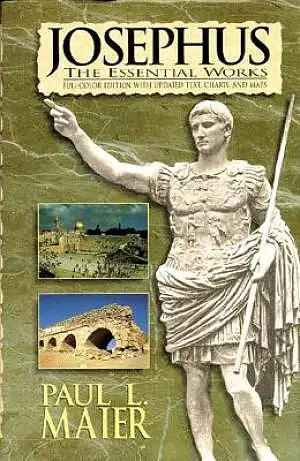
Josephus’ writings are the most important extra-biblical account and are of immense value in relation to Jewish history and the Bible. They are of great significance regarding biblical background and also the intertestamental period, often provide useful sermon insights and corroborate a vast number of biblical characters, places and events. In Paul Maier’s commentary on Josephus he states, “It is safe to say that if Josephus had not written, or if his writings had not survived, every biblical reference book, dictionary, encyclopedia, or commentary in our libraries today would occupy far less space on the stacks, and our knowledge of the biblical world would be impoverished.[i] This is in addition to Josephus’ famous quotations concerning Jesus, John the Baptist and James (Jesus’ half-brother).
Josephus wrote ‘Jewish Antiquities’ which is an extensive and detailed narrative running from creation until the end of the first century. ‘The Jewish War’ runs from the taking of Jerusalem by Antiochus Epiphanes until the taking of Jerusalem by Titus. In ‘Life,’ Josephus provides an autobiography defending his dishonourable conduct in Galilee at the beginning of the revolt which gives useful background information that relates to what follows later in his life.[ii]
Lesser known are the substantially shorter works, ‘Against Apion Book 1’ which is actually an apologetic for the antiquity of the Jewish Nation and engages with several critiques including that of the Egyptian Priest Manetho, who is well known for supplying valuable details concerning Egyptian King Lists, whilst ‘Against Apion Book 2’ specifically opposes Apion, the Graeco-Egyptian scholar’s writings.
Intriguingly, Josephus commences those latter books in a style remarkably similar to that of Luke in the openings of the books of Luke and Acts. Josephus writes, “I suppose that by my books of the Antiquities, most excellent Epaphroditus, I have made it evident to those who peruse them, that our Jewish tradition is of very great antiquity, and had a distinct subsistence of its own originally, as also, I have therein declared how we came to inhabit this country wherein we now live.”[iii] Luke writes, Inasmuch as many have taken in hand to set in order a narrative of those things which have been fulfilled among us, 2 just as those who from the beginning were eyewitnesses and ministers of the word delivered them to us, 3 it seemed good to me also, having had perfect understanding of all things from the very first, to write to you an orderly account, most excellent Theophilus, 4 that you may know the certainty of those things in which you were instructed.” (Luke 1:1-4)
The Life of Flavius Josephus
Josephus was born in AD37, proudly affirmed Hasmonean descent on his mother’s side, had an exceptional memory and was distinguished in learning as a boy.[iv]From the age of sixteen to nineteen he trialled the sects of the Pharisees, Sadducees and Essenes before conducting himself to the rules of the Pharisees.
In AD64, when Josephus was twenty-six, he sailed to Rome in an effort to secure the release of some Jewish priests whom the Roman governor Felix had sent to Nero for trial. Josephus was successful through the help of a Jewish actor Aliturus and Poppea Sabina. Soon after the return of Josephus to Jerusalem in AD66, the great Jewish war broke out and Josephus was appointed by the Sanhedrin in Jerusalem to defend Galilee.[v] Josephus played a controversial role since he was initially a commander of the Judean forces in Galilee, then surrendered during their siege at Yodfat and became an advisor to the Romans whilst trying to persuade Jerusalem’s defenders that to resist the Romans was impractical.[vi]
At Jotapata, whilst the Romans laid siege, Josephus and forty others hid in a large cave as they were the remaining survivors. When the Romans discovered them, they swiftly made a suicide plan to draw straws and kill each other rather than fall into the hands of their enemies. When only Josephus and one other man remained, they surrendered to Vespasian. Josephus duly predicted that Vespasian and his son, Titus would become emperors, which they did following the death of Nero. Josephus was released from prison after the prophecy came to fruition and was granted a privileged status thereafter. Josephus became both an intermediary and interpreter between the Roman and Jewish forces and was well recompensed by the Romans but bitterly cursed by the Jewish people as a traitor.[vii]
The life of Josephus was undoubtedly controversial, although he was an eyewitness to many first century events and his writings are invaluable. He was therefore able to report as an observer concerning the destruction of Jerusalem in AD70 and he provides important extra-biblical information concerning biblical political characters such as Herod the Great, Felix and Pilate and Herod’s extensive building projects.[viii]The most important aspects of his work are that concerning Jewish history from 100BC to 100AD from which he utilised a variety of authentic sources woven together skilfully.[ix]
Josephus Writings
Josephus’ writings are vast and whilst some have made attempts to condense his works and write them in a more accessible manner, it is worth reading the much more concise work ‘The Life of Josephus’ to gain an appreciation of the man and his setting. When studying the Tanakh (Old Testament) there is often valuable insight concerning the background of those accounts, so one can read a small portion alongside Scripture.
The intertestamental period is again of immense importance regarding Hannukah, the Hasmonean dynasty and also Alexander the Great, when he spared Jerusalem and had a favourable encounter with Jaddua the High Priest. It is worth reading specific parts of Jewish Antiquities in relation to the events surrounding the Maccabees alongside 1 and 2 Maccabees from the Apocrypha.
The writings of Josephus are also vital concerning the historicity of the Brit Hadasha (New Testament). Lawrence Mykytiuk wrote for the Biblical Archaeological Review confirming fifty-three people from the Hebrew Bible confirmed by archaeology and then later wrote concerning thirty people in the New Testament confirmed.[x] These characters were confirmed through either historical writings or evidence in inscriptions.
From the historical writings concerning New Testament characters these included Jewish writings such as the Talmud and Mishnah, Greek writers such as Lucian of Samosata and Celsus and Roman authors such as Tacitus, Pliny the Younger and Josephus. Having said the above, it is immediately apparent upon perusal of the table columns of this list that Josephus provides by far the most references to the New Testament characters. Moreover, because of when he lived and his particular occupations, he was able to report on some matters incredibly close to the time that they occurred and, in some cases, he could provide a first-hand account having been an eyewitness.
Josephus writings concerning Jesus
There are two quotes from Josephus concerning Jesus. The one below is disputed as having been rewritten in favour of Jesus, so some would say that it was too favourable to have been written by a Jewish source from that era.[xi] Nonetheless, there is no proof that insertions into the text have ever been made and they may well be authentic since they are included in every copy of Josephus in existence.[xii] Notwithstanding, the first believers in Jesus were Jewish and the New Testament setting is distinctly Jewish, whilst under Roman occupation. Furthermore Josephus wrote concerning many new testament characters and favourably about John the Baptist. There are also other independent historical accounts concerning Jesus from Jewish, Greek and Roman sources including the Talmud, Lucian of Samosata, Tacitus and Pliny the Younger and the Syrian Stoic philosopher, Mara Bar Serapion.
“Now, there was about this time Jesus, a wise man, if it be lawful to call him a man; for he was a doer of wonderful works, a teacher of such men as receive the truth with pleasure. He drew over to him both many of the Jews and many of the Gentiles. He was [the] Christ. And when Pilate, at the suggestion of the principal men among us, had condemned him to the cross, those that loved him at the first did not forsake him; for he appeared to them alive again the third day, as the divine prophets had foretold these and ten thousand other wonderful things concerning him. And the tribe of Christians, so named from him, are not extinct at this day.”[xiii]
[i] The New Complete Works of Josephus Translated by William Whiston Commentary by Paul L. Maier (Kregel, Grand Rapids, 1999), Introduction, p7
[ii] Marek Dospel 1st September 2025 The Histories of Flavius Josephus https://www.biblicalarchaeology.org/daily/people-cultures-in-the-bible/people-in-the-bible/the-histories-of-flavius-josephus/
[iii] The New Complete Works of Josephus, Against Apion Book 1:1, p937
[iv] Richard Gottheil, Samuel Krauss, Josephus Flavius https://www.jewishencyclopedia.com/articles/8905-josephus-flavius
[v] Ibid
[vi] Dospel
[vii] The New Complete Works of Josephus, Introduction, p9
[viii] Brenton H. Cook 1st January 2013 Is Josephus Reliable? https://answersingenesis.org/bible-history/is-josephus-reliable/?srsltid=AfmBOooGROtWQ11tFJNZyk7bOKK8Mm39FtIjwD3Jb9dTUPEQuwyKoyqj
[ix] Ibid
[x] Lawrence Mykytiuk 30 People in the New Testament Confirmed 9th February 2025 https://www.biblicalarchaeology.org/daily/people-cultures-in-the-bible/people-in-the-bible/new-testament-political-figures-the-evidence/
[xi] Matt Slick 8th December 2008 Regarding the Quotes from the historian Josephus about Jesus https://carm.org/evidence-and-answers/regarding-the-quotes-from-the-historian-josephus-about-jesus/
[xii] Ibid
[xiii] The New Complete Works of Josephus, Jewish Antiquities, Book 18, 3:3, p590