Jonah’s preservation
A great fish swallowed Jonah that the Lord prepared and from the belly of the great fish, Jonah prayed a prayer of thanksgiving. The book of Jonah is no mere allegory or metaphor but a series of literal events. Jonah paid for his fare on his way to Tarshish but did not require a return ticket since the Lord had prepared his return journey via the great fish. In Chapter 9 of Moby Dick entitled ‘The Sermon’ , Herman Melville helps us to consider the implications of Jonah’s penitent prayer, which unusually contained no petitions and is something we can all learn from.
“And now behold Jonah taken up as an anchor and dropped into the sea; when instantly an oily calmness floats out from the east, and the sea is still, as Jonah carries down the gale with him, leaving smooth water behind. He goes down in the whirling heart of such a masterless commotion that he scarce heeds the moment when he drops seething into the yawning jaws awaiting him; and the whale shoots-to all his ivory teeth, like so many white bolts, upon his prison. Then Jonah prayed unto the Lord out of the fish’s belly. But observe his prayer, and learn a weighty lesson. For sinful as he is, Jonah does not weep and wail for direct deliverance. He feels that his dreadful punishment is just. He leaves all his deliverance to God, contenting himself with this, that spite of all his pains and pangs, he will still look towards His holy temple. And here, shipmates, is true and faithful repentance; not clamorous for pardon, but grateful for punishment. And how pleasing to God was this conduct in Jonah, is shown in the eventual deliverance of him from the sea and the whale. Shipmates, I do not place Jonah before you to be copied for his sin but I do place him before you as a model for repentance. Sin not; but if you do, take heed to repent of it like Jonah.”[i]
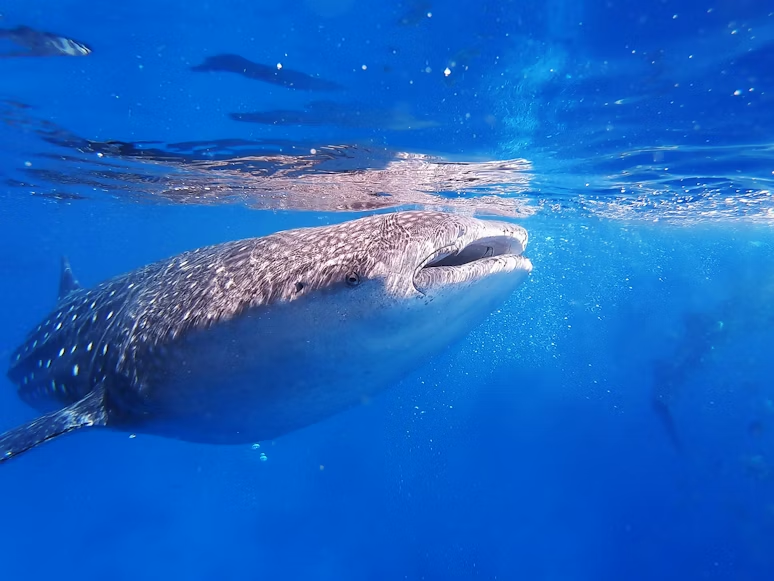
What was the sea creature that Jonah was swallowed and transported by? Some say a whale, or a shark, a sperm whale or a whale shark (the largest fish in the world). Interpreters have discussed this point over centuries and there are sufficient documented accounts of similar occurrences. One may venture in the whale room in the Natural History Museum and gaze upwards at the giant wonders of the deep suspended from the ceiling. I think it most likely was the whale shark, but one day we will know for certain.
How did Messiah refer to this event and how does this point us to Him (cf. Matthew 12: 38-42). Yeshua (Jesus) shows that Jonah is a type of Him and the sign of Jonah points to One far greater. Why would the men of Nineveh rise up in judgement and condemn that generation of scribes and pharisees? Even Nineveh repented, but the Messiah, the Prince of glory, the Son of God is far greater than Jonah.
Notice that in Matthew 12:38-42, Jesus mentions Jonah in the belly of the great fish and the Queen of Sheba’s visit as literal events. Similarly, why will the Queen of Sheba rise up in the judgement with that generation and condemn it? She journeyed to hear the wisdom of Solomon and she was more than a little impressed! What she had heard was no greater exaggeration, though the Lord Jesus is far greater than Solomon.
Jonah’s prayer of thanks
How would you have prayed to the Lord from the fish’s belly? Undoubtedly, you would pray in earnest, probably in the form of an arrow prayer. But how does Jonah pray? And what can we learn from how Jonah prays and how can we apply that to how we pray and when?
A number of commentators list nine psalms that Jonah draws from in his prayer. But taking an educated guess it is unlikely that Jonah had a book of psalms immediately to hand! So Jonah’s thorough reading and understanding of Scripture profoundly affects his prayer life and he is able to use that. There may come a time when our eyesight fails and we struggle to read. Verses in the psalms are spoken, sung, and also memorised. Throughout the ages, believers have been imprisoned for their faith in the Lord but they have memorised portions of God’s word. When we read and meditate upon the Scriptures, we can then apply that to so many life situations.
One of those psalms that Jonah draws from is Psalm 65 and the similarities between Jonah’s prayer and that psalm, are profound. Parallels include 1) A prayer of thanks 2) the sea and the waves 3) the temple 4) performing a vow 5) the God of salvation 6) the God who answers prayer 7) God’s providence in the use of ‘you’, ‘your’ (cf. Psalm 65:1-13). This shows the value of praying through and memorising Scripture.
Several interpreters emphasise that Jonah’s prayer is one of thanks! Walvoord & Zuck state, “This prayer by Jonah was not a plea for deliverance for there were no petitions in it. The prayer is a prayer of thanksgiving (v.9) to God for using the fish to save him from drowning.”[ii]
Bruckner’s application is useful. “In the end, Jonah’s prayer of thanksgiving is a witness of hope to believers. This hope has integrity and richness and when his thanks are seen in the narrative context of his situation. He gives thanks in spite of the uncertainty of still being at sea. He gives thanks knowing he did not deserve rescue. He gives thanks for a haven in an unlikely place. He gives thanks in spite of deep discomfort. Jonah gives thanks in spite of his unresolved questions and issues. His is a real and hopeful faith.”[iii]
Who threw Jonah in the sea? The mariners threw him in, but in Jonah 2:3, Jonah recognised that the Lord cast him into the deep. In verses 3-10 the use of ‘you’ and ‘your’ demonstrates the Lord’s providence in all these events. Jonah draws from Psalm 88 and Psalm 42 in relating to his experience.
In Jonah 2:4, we can see that Jonah was previously hiding from God, though now things have changed. Jonah was now seeking God, praying to God and thanking God. We must do the same and make use of the psalms and apply them to the scenarios that we encounter.
Jonah mentions the temple twice in this chapter. This reminds us of Solomon’s dedicatory prayer in 1 Kings 8. Jonah looked away from his great distress, all that was happening around him and looked towards the temple unto the Lord. Are you looking down and are you anchored to your problems, or are you looking to the Lord? Why did Jonah look to the temple? That was the meeting place with God. We are privileged in our time since the curtain of the temple was rent from top to bottom when Messiah was crucified. That means access with God is possible and we can meet with God and draw near to Him.
It is an awful thing to be described as ‘out of the Lord’s sight’ (Jonah 2:4), but how did Jonah respond? Jonah knew that wherever he was, he could look to God, cry out to Him and the Lord would answer him. Sometimes you may feel as if you are crying out to God, or seemingly there is no answer, or there appears to be a delay. Yet the Lord had prepared the great fish to swallow Jonah and to return him, in more ways than one! Jonah prayed and God answered. Sometimes we pray and the Lord answers but not always the way that we anticipate. Jonah cried out and God heard his voice. The Lord sees our distress and answers our prayers.
Jonah described most vividly, the conditions inside the belly of the great fish. The waters surrounded and engulfed him, even to his soul. No doubt it was noisy, relentless and disorientating and it would be difficult to ascertain any sense of time or location. The deep closed around him. He may have felt claustrophobic being contained inside a cavernous, large fish. He may well have experienced intense pressure from the depths of the sea and it might have been dark inside. It probably stank and there were in all likelihood, smaller fish lying around in this watery graveyard.
Jonah was positioned inside the digestive processes of this colossal sea creature, something akin to a living washing machine. One survivor of a similar account recalled the unbearable heat at which point he passed out unconscious. Amazingly, Jonah was not digested, though his skin may have been altered, giving him a whitened appearance when he emerged onto dry land.
Verse 6 explains that Jonah was transported to the depths of the seas into unchartered territory. This is something like a waking nightmare, actually happening and then the Lord raised his life from the pit. In the King James Version, ‘the pit’ is rendered as ‘corruption’. In Strongs Concordance, ‘shacath’ (7845), the same word used in Psalm 16:10. Some commentators state that Jonah died inside the belly of the great fish, whilst others do not. The essential point is that Jonah is both a type and sign of Messiah’s resurrection.
In the Tanakh (Old Testament), there is both a certainty of the believer’s resurrection and also that of the believer (Psalm 16:9-11). Hence David was certain of a better resurrection because Messiah would rise. Job knew the same (Job 19:25-27) and so did Daniel, which gives us hope (Daniel 12:2-3). Peter recognised Yeshua’s resurrection when he preached powerfully at Pentecost quoting (Psalm 16:9-11; cf. Acts 2:27).
We must believe Jonah, David, Job, Daniel and Peter and trust in the Lord Jesus for a better resurrection. The resurrection of our Lord is the greatest miracle and the basis of lasting hope for eternity. How can you be certain that the Saviour rose and that one day you will also rise? In addition to the many specific fulfilled prophecies and the numerous detailed eye-witness accounts and the post resurrection appearances of Messiah, remember this. The Romans could not produce the body of the Messiah. It should not have been difficult for them to go to the tomb and then provide evidence of His body. That is all they had to do. Bring out the body and then everyone could go home and that would be the end of it. But they could not because He actually had risen and His resurrection is the guarantee of a better resurrection of the believer.
Moreover Matthew 27:62-66 informs us that the Pharisees and Sadducees anticipated that the body of Jesus might be stolen. So the tomb was made secure, a heavy stone was rolled in place and sealed, and the guard was set. Yet some of the guard reported what happened and they were bribed with a hefty sum of money. The reason why the Romans could not produce the body of the Messiah was because He had risen.
But why were the soldiers not executed for dereliction of duty? It is not every day that darkness appears during the day as Messiah was crucified. It is not every day that as our Lord prays for the transgressors, earthquakes occur, saints are raised and appear to many. And furthermore, it is not every day, that the curtain in the temple, thick as a man’s hand is rent from top to bottom. That was a day like none other!
Jonah’s temple references point us to the Lord who died and rose and to whom the believer now has access. Although Jonah’s soul fainted within him, he remembered the Lord and his prayer was heard. His prayer went up to the Lord and His holy temple. We should pray to the Lord in all situations. Matthew Henry wrote, “A sense of God’s good-will to us, notwithstanding our offences, opens the lips in prayer, which were closed from the dread of wrath. Also, where he prayed; in the belly of the fish. No place is amiss for prayer. Men may shut us from communion with one another, but not from communion with God. To whom he prayed; to the Lord his God. This encourages even backsliders to return.”[iv]
Momentarily, Jonah compares his hope with those who trust in idols, but why? Because whatever is most important in your life will inevitably become your idol. We must trust in the Lord and forsake idolatry. We must cling to God rather than trusting in ourselves, or the vanity of our imagination. To refuse God is foolish, like clinging to a sinking ship. Why forsake His lovingkindness?
Jonah’s deliverance
Can you relate to Jonah and are you thankful? We were all heading off course, lost at sea and with no hope in this world. We lived according to our desires and our way. We cried out to God and He heard our prayers. We have all like sheep gone astray. But even before then, the Lord prepared and orchestrated our life events and has been gracious to us. He made a way when there was no way because He is the way, the truth and the life. We do not know exactly what Jonah vowed. It may have involved going to Nineveh even though he did not want to go there. But he intended to observe his vow.
In Jonah 2:9, Jonah crucially proclaims that salvation is of the Lord. Are you saved? There are ultimately in terms of salvation, two categories of people, the saved and the unsaved. There are those who are trusting in the Lord and there are those who are trusting in themselves. This reminds us of Yeshua, the Messiah. Why is He called Yeshua (Jesus). His name speaks of salvation and He saves us from our sins. Only the Saviour has the power, ability and the grace to forgive our sin.
What does it look like to trust in ourselves? William Ernest Henley’s poem ‘Invictus’ summarises this exactly. The poet trusts in himself rather than God. They bear circumstance and chance rather than God’s providence. He thanks the unnamed gods, for his unconquerable soul, instead of the God who created him. He wilfully avoids the straight gate and the punishments of the scroll which is harrowing.
“Out of the night that covers me, black as the Pit from pole to pole,
I thank whatever gods may be for my unconquerable soul.
In the fell clutch of circumstance I have not winced nor cried aloud.
Under the bludgeonings of chance my head is bloody, but unbowed.
Beyond this place of wrath and tears looms but the Horror of the shade,
And yet the menace of the years finds, and shall find, me unafraid.
It matters not how strait the gate, how charged with punishments the scroll,
I am the master of my fate: I am the captain of my soul.”[v]
Now let us compare Invictus with the end of the sermon from Moby Dick.
Jonah did the Almighty’s bidding. And what was that, shipmates? To preach the Truth to the face of Falsehood! That was it!
“This, shipmates, this is that other lesson; and woe to that pilot of the living God who slights it. Woe to him whom this world charms from Gospel duty! Woe to him who seeks to pour oil upon the waters when God has brewed them into a gale! Woe to him who seeks to please rather than to appal! Woe to him whose good name is more to him than goodness! Woe to him who, in this world, courts not dishonor! Woe to him who would not be true, even though to be false were salvation! Yea, woe to him who, as the great Pilot Paul has it, while preaching to others is himself a castaway!”[vi]
The Lord who spoke to the fish that vomited Jonah onto dry land, also spoke this world into being. Jonah being swallowed but not digested and his transportation, possibly to Joppa, was a miracle. Throughout the book of Jonah, God’s providence is displayed through a whole series of miracles. Sure, the Lord is sovereign, upholding the universe and if not for a mere second, could we draw our next breath? But He is also working providentially in the lives of believers and we should give Him thanks and praise for that.
So whatever situation you are facing, the Lord can take your feet from the miry clay and place them onto dry ground. Like Jonah, we must be prayerful, thankful and looking to Him. Spurgeon reassures us that God’s sovereignty is His most comforting attribute. Remember that the Lord watches over us. As we journey through the storms of life, the Lord is working in our lives and guiding us. The Apostle Paul also encouraged us, “being confident of this very thing, that He who has begun a good work in you will complete it until the day of Jesus Christ;” (Philippians 1:6)
[i] Herman Melville Moby-Dick or The Whale (Penguin, 1980; New York), p52
[ii] John F. Walvoord & Roy B. Zuck (Editors)The Bible Knowledge Commentary Old Testament An Exposition of the Scriptures by Dallas Theological Seminary (Victor, 1989; USA), p1467
[iii] James Bruckner The New NIV Application Commentary Jonah, Nahum, Habakkuk, Zephaniah (Zondervan, 2004; Grand Rapids), p87
[iv] Matthew Henry Matthew Henry’s Concise Commentary on the Whole Bible (Moody, Chicago), p642
[v] William Ernest Henley Invictus poets.org https://poets.org/poem/invictus?gad_source=1&gad_campaignid=16752247&gbraid=0AAAAAD_ZODk4bgQJ3X8ZLPjG6L9ujJt_l&gclid=EAIaIQobChMIi4SjvYD6kQMVx5pQBh0fzBxuEAAYASAAEgK2HPD_BwE
[vi] Melville, p53-54