The Louvre Museum is the largest museum in the world, attracting over eight million visitors annually and it contains an extensive repository of biblical artefacts. Far less literature has been written concerning the Louvre and the Bible compared with the British Museum and the Bible.
Unlike the British Museum, there is scarce information relating to biblical references on the accompanying information boards. Some of the display boards are written in French and others are written in French and English. Many names of biblical rulers have a different name in French, but since some names are almost identical, by examining the length of their reign, they are easily recognisable. Using google lens is useful in translating the text, though even a basic level of French proves helpful in ascertaining some of the text.
If you are planning to visit the Louvre it is certainly advisable to prepare well in advance and to familiarise yourself with the floor plans, wings and galleries. It is worthwhile checking the weekly schedule of open rooms to determine which galleries can be seen on a particular day. Please note that the museum is closed on Tuesdays and every other day of the week has a particular schedule of rooms, open and closed. Due to the far-reaching size of the Louvre and the vastness of the collection, ongoing maintenance is a given. Here then, is my report of my two visits. During those visits, I was able to view everything that I had planned to see, other than the items in the Roman galleries.
Egyptian antiquities
In the Sully Wing on Level 1, there is a chronological display of the Egyptian exhibits. To optimise the usefulness of a trip and to save an inordinate amount of time, it is helpful to either orientate oneself with or bring an Egyptian King List detailing the reigns of the pharaohs in their respective dynasties. So commencing from the most ancient findings, here are the items of biblical interest.
In the twelfth dynasty there are several artefacts relating to Sesostris III (Senusret III) who was most likely the pharaoh reigning whilst Joseph was prime minister in Egypt. In addition to the dates of his reign, he is easily distinguishable by his prominent ears. Some have conjectured that this feature signified being attentive to hear the needs of his subjects. A curator from the British Museum comments that the oversized ears and recognisable facial features identify this figure as Senusret III of which there are over a hundred known statues.[i]
At the Louvre, there is a statue of Sesostris III as a juvenile, a door lintel, and another statue of his torso and head from the Temple of Montu at Medamud, near, Luxor, Egypt. In addition, there are a few head portraits of assorted colours and stones as well as the distinctive black granite statues in varying conditions. There is also a diorite seated statue of the mother of Sesostris III who was the wife of Sesostris II.
The eighteenth dynasty is one of the most well-known Egyptian dynasties since that relates to Akhenaten who was involved in the Amarna heresy and also Tutankhamun, whom when his tomb was discovered just over a century ago, became a household name. Not surprisingly, there are artefacts in the Louvre relating to the above mentioned. Of biblical interest however, there are several artefacts relating to Tuthmosis III and Hatshepsut.
There is considerable controversy as to whether Tuthmosis III or Rameses II was the pharaoh of the Exodus depending on whether one favours the early or the late date for the Exodus. Those arguing for the late date, mention that the children of Israel were building store cities in Pithom and Raamses (Exodus 1:11) and some link the Habiru who were involved in slave labour building grain cities with the Hebrews. Nonetheless, it is far more likely that the Habiru was a generic term for a wider group of people rather than a single ethnic group such as the Hebrews.
The Biblical dates all favour the earlier date for the Exodus. 1 Kings 6:1 confirms that in the fourth year of the reign of Solomon, that was the four hundred and eightieth year after the children of Israel exited Egypt. Acts 13:20 tells us that there were judges for about four hundred and fifty years until Samuel the prophet and Judges 11:26 informs us that for three hundred years Israel dwelt in Heshbon and its villages, Aroer and its villages and in all the cities of the River Aroer (east of the Dead Sea) in Modern-day Jordan.
Furthermore the name Tuthmosis III appears to resemble that of Moses[ii] and noticeably Tuthmosis I, Tuthmosis II, Tuthmosis III and Tuthmosis IV were all pharaohs in the eighteenth dynasty.[iii] Ahmose I was the first pharaoh of the eighteenth dynasty and Kamose was the last pharaoh of the seventeenth dynasty.[iv] Ramases I and Ramases II occur in the 19th dynasty and Ramases III through to Ramases XI are found in the twentieth dynasty.[v] With reference to the biblical timeline it is likely that Hatshepsut was pharaoh’s daughter who took pity on Amram and Jochebed’s child and who named him ‘Moses’.
If however, you do consider Ramases II to be the pharaoh of the Exodus, there is a huge obelisk pertaining to him, located at the Place de la Concorde, just a short walk from the Louvre. If you favour the early date as I do, then you can see Cleopatra’s Needle by the River Thames in London which was actually made in his honour as was the Cleopatra’s Needle in Central Park, New York.
In the Louvre, there are several statues and scarabs of Tuthmosis III and Hatshepsut, plus a small sphinx of Tuthmosis III. Items relating to the Annals of Tuthmosis with reference to his military campaigns can also be observed. Bas reliefs of the temple in Elephantine in the reign of Tuthmosis III and Hatshepsut may be viewed. Many artefacts in connection with Hatshepsut such as obelisks or stelas can be seen in museums across the world and her temple near the Valley of the Kings in Luxor is particularly spectacular, impressive both in magnitude and aesthetic quality.
The Great Sphinx of Tanis displays the head of a pharaoh and the body of a lion. This was carved from pink granite in the thirteenth dynasty though the pharaoh’s name was erased. Erasing a pharaoh’s name was not uncommon and the same occurred to those who were involved in the Amarna heresy (who worshipped the sun God Aten as opposed to polytheistic worship) and many reliefs relating to Hatshepsut have also similarly been defaced. The base and chest of the sphinx were inscribed with the names of Ramases II; the right shoulder has Merneptah inscribed and there is also an inscription on the left shoulder of Shishak I (first ruler of the twenty second dynasty) mentioned in 1 Kings 11:40; 14:25; 2 Chronicles 12:1-12).
A few items relating to Pharaoh Apries (twenty sixth dynasty) include a bronze sphinx, a statue of his head which is partly damaged and another head statue, again partly damaged or defaced, though it is uncertain whether that pertains to Apries or Amasis who seized the throne during a revolt against Apries. Apries is Pharaoh Hophra in the Bible of which there is a single, yet important reference to him in Scripture. “Thus says the Lord: ‘Behold, I will give Pharaoh Hophra king of Egypt into the hand of his enemies and into the hand of those who seek his life, as I gave Zedekiah king of Judah into the hand of Nebuchadnezzar king of Babylon, his enemy who sought his life.’ ” (Jeremiah 44:30) Concerning Nebuchadnezzar, the Louvre Museum also contains artefacts relating to him, but I will revisit that later.
A small black statue of Taharqa (twenty fifth dynasty Kushite/Nubia) can be seen presenting the falcon god Hemen with a vase. There is only a single reference to Tirhakah in Scripture in 2 Kings 19:9 where he aids Hezekiah against Sennacherib who was intent though not successful in taking Jerusalem. Interestingly, Taharqa is one of the more famous pharaohs and there are more pyramids in Northern Sudan than in Egypt although they differ markedly in composition and stature. In the Ashmolean Museum in Oxford, one can see Taharqa’s colossal shrine together with a rock sculpture of him under the protection of Amun.
Mesopotamia, Assyria and Babylon
In the Richelieu wing on Level 0, ‘The Code of Hammurabi’ is recognisable as a prominent, approaching eight-foot-high stone and is one of the more well-known archaeological exhibits. In generic terms, this is the ancient Babylonian equivalent of the Torah and the Ten Commandments. As well as the black basalt stela of the Code of Hammurabi where Hammurabi is depicted as receiving laws from the sun god Shamash, there is a small sculpture of his head, plus fragments of the code written on tablets. Edwards and Anderson note some similarities regarding reference to responding to a goring ox (Exodus 21:28-36), but also marked differences such as anyone caught looting at a fire was to be thrown into the fire and punishments for physicians not able to cure their patients![vi]
There is a chronological list of the Kings of Larsa and whilst there might be significant discrepancies concerning the details, they do serve a purpose regarding piecing together some of the rulers. Of greater importance is the Sumerian King List, also known as the Weld Blundell Prism, housed in the Ashmolean Museum in Oxford which contains a King List before and after the flood. Again there may be difficulties concerning the accuracy of the narratives and the extreme lengths of the reigns of the earlier rulers, though the point of interest is the commonality of numerous ancient accounts of a worldwide flood.
Various artefacts give us an insight into the ancient world in around the time of Abraham. Mathematical and geometric tablets can be viewed plus tablets showing the division and the conversion of fractions, creation accounts, astronomical horoscopes and the calendar of the Zodiac which bridges the gap between their time and civilization and ours.
A particular highlight was viewing items that originated from Sargon’s palace from Khorsabad. In ancient times, Dur-Sharrukin meaning ‘Fortress of Sargon’ was located there and the site was abandoned by Sennacherib and then much later on Khorsabad was built over its ruins. Originally Paul Emile Botta commenced excavations at the site of Nineveh but did not excavate sufficiently deep enough and then turned his attention to Khorsabad. Nonetheless, the findings at Khorsabad were so remarkable that initially Botta presupposed he had discovered artefacts relating to Nineveh. However, it was Austen Henry Layard who brought many items from Nineveh to the British Museum, though both men made outstanding contributions to the field of biblical archaeology.
Sargon II is referred to just once in Isaiah 20:1. “In the year that Tartan came to Ashdod, when Sargon the king of Assyria sent him, and he fought against Ashdod and took it,” Several lamassu (winged bulls with human heads) are strategically placed at door entrances as they would be at Sargon’s palace. These mythical creatures served the role as imposing guardians. The head was that of the King (in this case Sargon) giving the idea of a combination of deity and humanity. This is similar compared with the sphinx statues which contain the body of a lion and the head of a pharaoh. The bull typically depicted strength, the wings characterised speed and the head wisdom.
Some of the lamassu have five legs. One might guess that this is for stability for they are colossal weighty statues some of which are 13ft high and weigh several tonnes. Both Botta and Layard utilised marble cutters to reduce the vast weight before transporting their respective enormous statues. Joseph Bonomi wrote that the most challenging obstacle was the process of moving great blocks and it took six weeks to construct axle-trees to support the enormous load.[vii] Layard mentioned that the ropes in his vicinity were not strong enough to bare the considerable weight and he used levers of wood and dug away the sun-dried bricks from behind the slabs before they were sawn.[viii]
The Chicago Oriental Institute (recently renamed ‘Institute for the Study of Ancient Cultures’) also house some of these lamassu and the information board in the Louvre refers to them. The more likely reason for the five-legged phenomena, however, is the sense or impression of movement as one passes into a palace or a great columned hall. Fascinatingly on the A31 in Dorset, the five-legged stag stands atop the base of the Charborough Park Estate Gate owned by the Drax family bridging the ancient world with our present time.
The room where the antiquities of Sargon’s Palace is displayed is ample and uncrowded and there is a whole series of reliefs portraying a hero holding a lion in his arms and scenes of military campaigns, riding horses, archers and servants carrying a banquet, a seat and a vase. Assyrian protective spirits have an unusual otherworldly appearance and several reliefs portray the transportation of the cedars of Lebanon which immediately reminds us of the cedars of Lebanon being prepared for Solomon’s temple (1 Kings 5:6). The display boards are useful here with diagrams of the excavation and layout of the palace in Khorsabad. Noticeably there is a relief of Sargon with an unnamed dignitary. There is a similar relief in the British Museum with Sargon and his son Sennacherib.
In the walk-through areas behind, there are bricks inscribed with ‘Nebuchadnezzar’ from his North Palace in Babylon. There is also a beautiful, glazed representation of a lion. This is the Nebuchadnezzar II of the Bible. The Nabonidus Cylinder is small but of biblical significance. Nabonidus was the father and co-regent of Belshazzar which helps us to understand why in Daniel 5:29, Daniel was appointed the third ruler in the kingdom and not second in command like Joseph, who was appointed as prime minister to pharaoh (Genesis 41:40).
There is a neo-Hittite Sphinx which is of biblical relevance since the Hittites are mentioned in numerous places in Scripture and in Genesis 23:1-20 Abraham purchased a burial place for Sarah from Ephron the Hittites. The higher critics used to contend that the Hittites never existed though in there is extensive evidence for the Hittite people in our time.
Several items from Arslan Tash (northern Syria) can be seen and some of the information boards relate those items to the reign of Tiglath Pileser III including a headless god, guardian bulls at the temple of Ishtar and a storm god Baal brandishing a thunderbolt. King Ahaz sent messengers to Tiglath-Pileser III asking him to save him from the king of Syria and the king of Israel who had come up against him (2 Kings 16:7). The Arslan Tash Ivories are shown in a large glass case and reference is made to Hazael. He is the biblical king mentioned in 2 Kings 8:7-15 who murdered Ben-Hadad King of Syria and he then reigned in his place.
There is usually a prism of the campaigns of Ashurbanipal viewable, although on my visit, this item appeared to be on loan. There are wall reliefs relating to Ashurbanipal’s lion hunting which fits the background of Nahum 2:11-13 and 2 Kings 17:24-26. A more extensive display of that can be viewed in the British Museum. Ashurbanipal is mentioned by his Aramaic name as ‘Osnapper’ in Ezra 4:10 as the ruler who took nations and settled them in the name of Samaria. His Aramaic name is given in the Bible since Daniel 4:8-6:18 was written in Aramaic.
Further reliefs of Tiglath Pileser III palace in Nimrud can be seen although the display labels do not provide much information other than relating to the king himself, archers, warriors and royal servants.
One of the most important biblical artefacts exhibited in the Louvre Museum is the Moabite Stone also know as the Mesha Stela. The inscription by King Mesha of Moab (cf. 2 Kings 3:4-5) memorialises his revolt against Israel and rebuilding of several important towns. It also mentions King Omri of Israel, provides an early reference to the Lord’s name in the form of the tetragrammaton and an almost certain record to King David. On close examination the cracks can be seen on the Moabite Stone. In 1868, during the time of the Ottoman Empire the Arabs constructed a fire and poured cold water over it, causing it to break into pieces with the intention of making it even more valuable, hence the stone was bought and pieced together.[ix]
Iran, Levant and Arabia
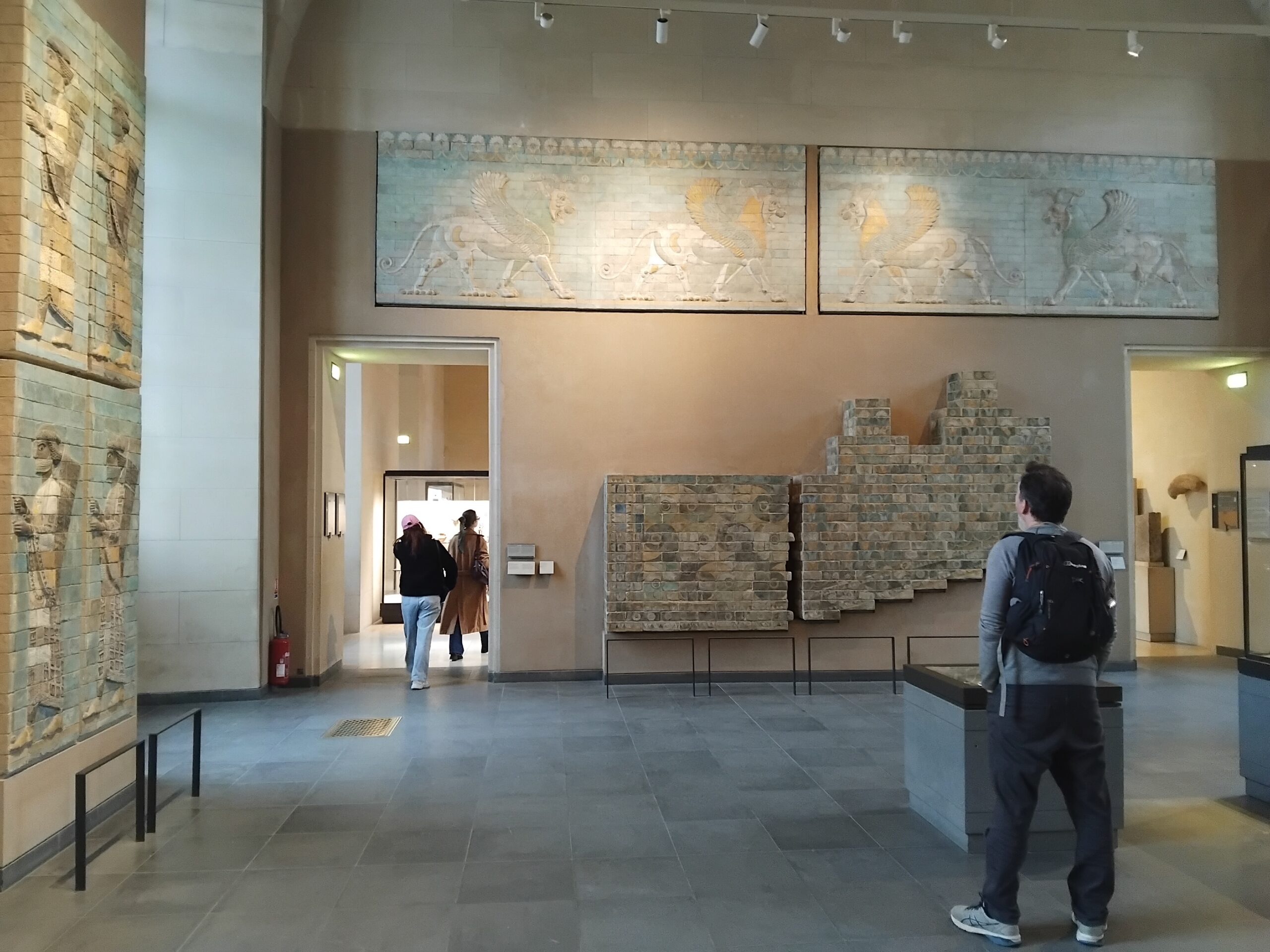
The display from the Palace of Darius I in Susa is one of the most dramatic and intentionally well displayed biblical archaeologically exhibits in the Louvre. In 1907, Ira Price writing for the University of Chicago Press Journal marvelled, “So admirable is its proportions, and so regal its appointments that the authorities of the Louvre have spared no pains to reproduce in one of the Persian rooms the characteristic features of this palace”.[x]
This is the Darius mentioned in Haggai 1:1 and Zechariah 1:1 in the Bible. The colouring and brilliance of the tiles is vivid and striking and there are scenes of archers and winged lions, reminding us of the book of Daniel and the lion with eagles’ wings (Joseph Bonomi made mention of the same in his classic work )[xi] and bulls on columns like a double-headed knights from a chess set. There is also a stepped stairway parapet with lotus flowers, a frieze of lions, and two sphinxes under a winged disc. That most likely relates to the Zoroastrian symbol relating to Ahura Mazda and similarly in the British Museum the faravahar emblem can be seen in relation to Darius.
Darius commenced the construction of the palace at Susa and his son Xerxes completed it. Xerxes is the King Ahasuerus of the book of Esther and is also referenced by the classical writers such as Herodotus. It was his army that fought the Spartans at the battle of Thermopylae. There is also an interesting coin collection, some of which include Darius and Xerxes as archers, probably trying to give the impression of heroic strength and ability to lead and protect the people. There is a 121 Kg lion weight, not unlike the other one found in Babylon and surely reminds us of Belshazzar’s feast when he was numbered, found wanting and his kingdom was divided (Daniel 5:25-30). There are other tablets relating to both Darius and Xerxes.
A silver bowl that resembles closely those housed in the British Museum mentions Artaxerxes on the display board. Those bowls in the British Museum reference Artaxerxes, Xerxes and Darius inside the rim of the bowl! It is likely that this artefact might have been another of his bowls. Nehemiah was the cup bearer to Artaxerxes (Nehemiah 2:1), so it is possible that he may have drunk from those vessels.
A pink granite fragment of a stela commemorating the opening of a canal is known as ‘The Stela of Shaluf’. The display board informs us that King Darius oversaw the completion of this project linking the River Nile and the Red Sea but also adds that it began under Pharaoh Necho II. Necho II is the pharaoh who tried to avoid war with King Josiah and wanted to fight against Carchemish and sent messengers to cause Josiah to reconsider. Tragically Josiah went to war, disguised himself so that he might fight him and was shot by the archers. All Judah and Jerusalem mourned for him (2 Chronicles 35:20-27).
Rome
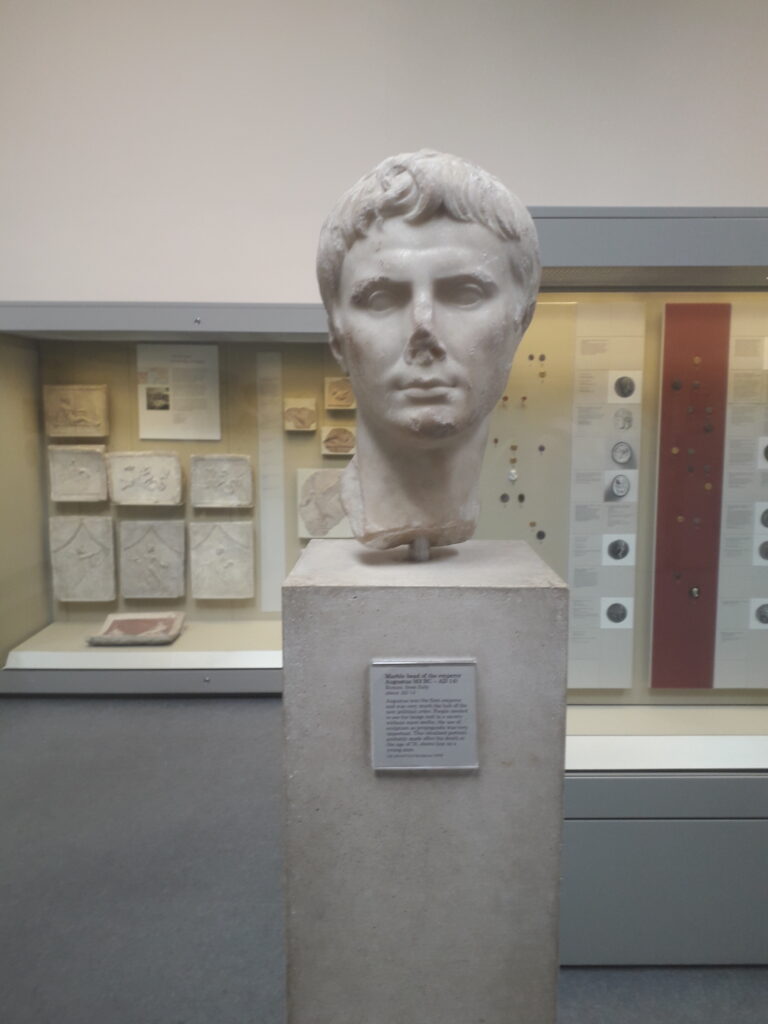
During my two visits I was not able to see the Roman Antiquities located in Denon Wing Level 0 because of ongoing maintenance work. However, there are three Roman Emperors mentioned in the Bible by name, Augustus Caesar, Tiberius Caesar and Claudius Caesar (Luke 2:1; 3:1 Acts 11:28; 18:2). The unnamed fourth emperor can be identified as Nero due to the historical timeline of Paul’s missionary Journeys and when Paul sought to appeal to Caesar, (Acts 25-26; 28:19). In the Louvre there are statues of Augustus Caesar and Tiberius Caesar, a marble portrait of Claudius Caesar and a youthful statue of Nero, plus a bust sculpture of him.
It was Augustus Caesar who gave the decree for all the world to be registered and that was why Joseph and Mary came to Bethlehem. Tiberius Caesar was reigning whilst Pontius Pilate was the governor of Judea. There was a great famine throughout the world in the days of Claudius Caesar and Claudius also expelled the Jewish people from Rome. Nero was notoriously cruel, antisemitic, blamed the fire in Rome on the Christians and was highly unpredictable. Classical literature also provides much background information on these characters.
There are marble statues in the Louvre of Emperor Vespasian who entrusted his son Emperor Titus to lay siege and to then destroy the Temple in Jerusalem AD70. Several of the emperors had their names used to replace the names of the months of the year. July and August are still named after Julius Caesar and Augustus Caesar even to this day. Today, Israel is fulfilling prophecy and is re-established whilst the great world empires have risen and fallen. Also, the Lord knows the end from the beginning and His reign is from everlasting to everlasting. The Lord Jesus left from the Mount of Olives and He is coming again and will return there to rule and to reign. Are you trusting in the God who owns history and will you be ready when Messiah returns?
[i] Senusret III https://www.britishmuseum.org/collection/object/Y_EA36298
[ii] Editors John F. Walvoord & Roy B. Zuck The Bible Knowledge Commentary An Exposition of the Scriptures by the Dallas Theological Faculty Old Testament (Victor, 1989; USA), p110
[iii] Teagan Wolter List of Pharaohs of Ancient Egypt https://www.britannica.com/topic/list-of-pharaohs-of-ancient-Egypt
[iv] Ibid
[v] Ibid
[vi] Brian Edwards & Clive Anderson Through the British Museum with the Bible 5th Edition (Day One, 2015; Leominster), p80
[vii] Joseph Bonomi Nineveh and its Remains: The Discoveries of Botta and Layard Applied to the Elucidation of Holy Writ (Elibron Classics, 2005; London), Replica edition of the edition published in 1852, p23
[viii] Austen Henry Layard Nineveh and its Remains (Pantianos Classics, 1848), p84
[ix] The Zondervan Pictorial Bible Dictionary, General Editor Merrill C. Tunney (Zondervan, 1963; London), p550
[x] Ira Maurice Price Monuments in the Louvre Museum Illustrative of Biblical History (The University of Chicago Press, December 1907), Volume 30, No.6,pp.402+429-437
[xi] Bonomi, pii (preface)