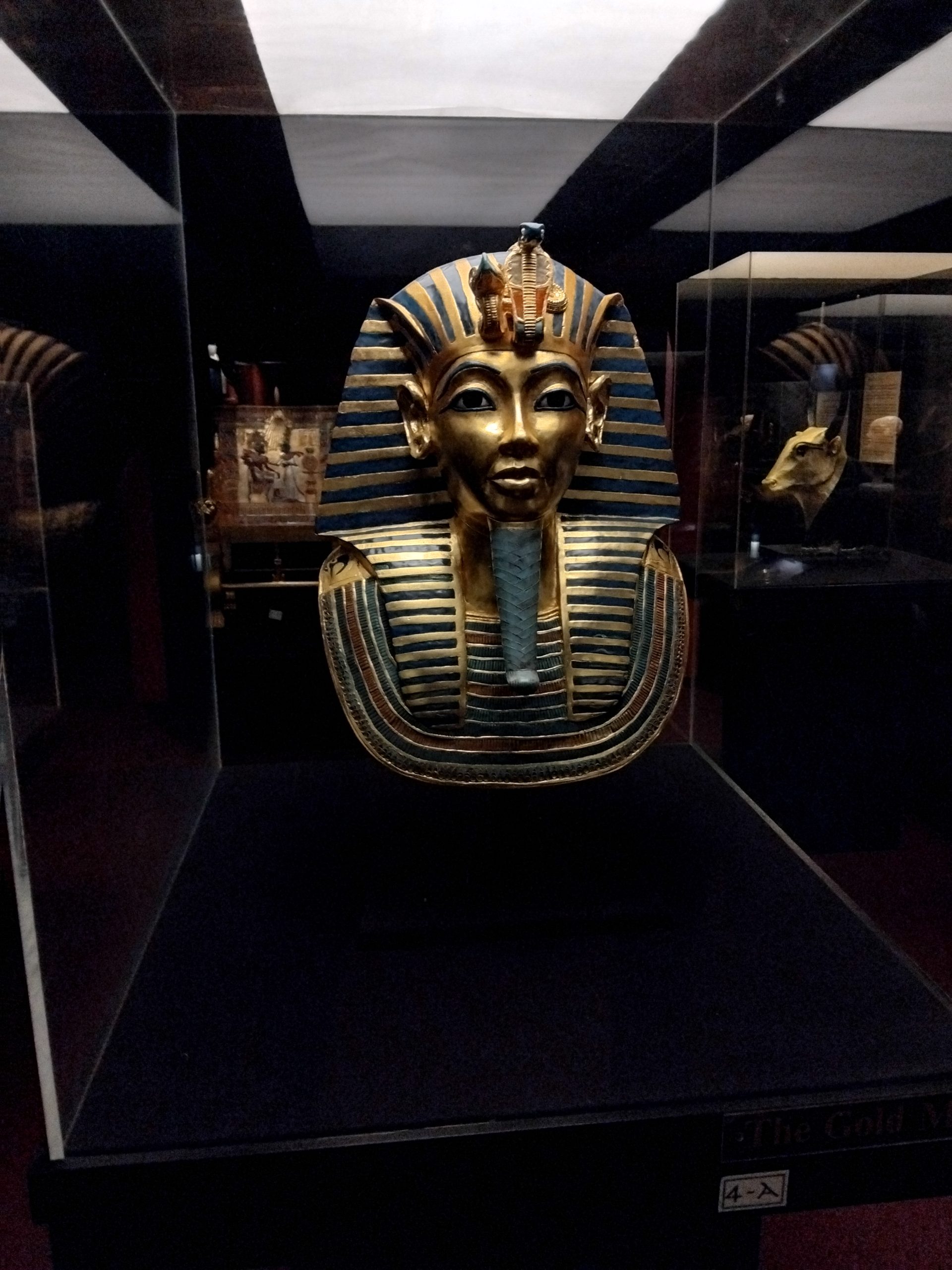
The Tutankhamun Exhibition in Dorchester is well worth a visit since it illuminates our understanding regarding the background setting of the Bible. Some names of the Egyptian gods relate to false gods mentioned in Scripture. The 18th Egyptian Dynasty includes the timeframe of the Exodus and the Golden Cow and Apis bear some degree of resemblance to the Golden Calf from the book of Exodus. There is also a replica skeleton of Tuthmosis II who was probably Pharaoh when Moses fled from Egypt, after killing an Egyptian who was beating a Hebrew slave. The relatively recent discovery of the Tuthmosis II Tomb was another important discovery.
In addition to the Tutankhamun Exhibition itself, a display board in the museum opens up another important local connection with Egyptology. Giovanni Battista Belzoni arranged the shipment of a whole range of Egyptian artefacts across Europe. Also, W.J. Bankes purchased from Egypt a stone obelisk and placed it in the garden of his home in Kingston Lacy, near Wimborne. This obelisk contains the cartouches (name rings) of Ptolemy and Cleopatra which when compared with the Rosetta Stone helped to confirm the decipherment of the latter. The Rosetta Stone was of course critical in understanding and decoding hieroglyphics on Egyptian artefacts.
Egyptian gods, name changes, the Amarna heresy and Tutankhamun
If you peruse an Egyptian King List from Britannica or the Metropolitan Museum of Art and examine the names of the 18th Dynasty pharaohs, many of them not surprisingly relate to Egyptian gods. Combined with that, there are also a number of interesting theologically and politically driven name changes. Tutankhamun whose name means ‘living image of Amun’ was born as Tutankhaten meaning ‘living image of Aten’. He changed his name to Tutankhamun when he became Pharaoh aged just nine years of age. Similarly, Tutankhamun’s wife was born with the name Ankhesenpaaten meaning ‘she lives for Aten’ which was later altered to Ankhesenamun meaning ‘she lives for Amun’.
Relatively little is known about Tutankhamun’s life but to gain further insight it is necessary to consider his predecessors. The Tutankhamun Exhibition provides useful information boards regarding Akhenaten and the Amarna heresy which was a critical period in Egyptian history involving a shift from polytheism to monotheism and in this case the worship of Aten the sun god. In addition, the ancient capital from Karnak was moved to Amarna (between Memphis and Thebes), further along the Nile in the direction of Lower Egypt. Other museums such as the British Museum, Louvre, Ashmolean Museum and Fitzwilliam Museum have artefacts and insightful information relating to the Amarna period too.
Akhenaten destroyed statues, temples, or images of other gods and particularly that of Amun. This is comparable to today with people who destroy statues of figures that are in opposition to their political or religious viewpoints. Akhenaten and his wife Nefertiti are easily recognisable since they are portrayed with highly stylised, artistic, even fashionable features and the family portraits show much more familiarity and family intimacy than statues of other pharaohs, or Egyptian royal families. Nefertiti was also famous in the ancient world for being exceptionally pretty. Her full and later name Neferneferuaten-Nefertiti means ‘a beautiful woman has come’ and the ‘aten’ part relates to Aten.
Akhenaten was formerly called Amenhotep IV but changed his name to Akhenaten reflecting his change from polytheism to monotheism, affirming Aten and especially rejecting Amun. Tutankhamun later reintroduced traditional polytheism. Egyptian names that include ‘Amon’, ‘Amen’ or ‘Amun’ in Egyptian chronologies relate to the god Amun.
The Biblical connection-Amun & Aten
Amon is mentioned in the Bible. Jeremiah prophesied against Pharaoh who would be delivered to his enemies. Note the reference to the Lord being against Amon of Thebes. “The Lord of hosts, the God of Israel, says: “Behold, I will bring punishment on Amon of No and Pharaoh and Egypt, with their gods and their kings—Pharaoh and those who trust in him. And I will deliver them into the hand of those who seek their lives, into the hand of Nebuchadnezzar king of Babylon and the hand of his servants. Afterward it shall be inhabited as in the days of old,” says the Lord.” (Jeremiah 46:25-26)
In Nahum 3:8, Nineveh is compared with No Amon (Ancient Thebes) before judgement at the hands of the Babylonians and the Medes. “Are you better than No Amon that was situated by the River,
that had the waters around her, whose rampart was the sea, whose wall was the sea?” There are a huge number of artefacts relating to Amun, often in the form of a Ram both in Egypt and in the world’s museums. Frequently, Amun is depicted in the form of a Ram, with Pharaoh Taharqa nestled underneath him. Tirhakah acted as an ally to King Hezekiah of Judah and King Sennacherib of Assyria (2 Kings 19:9; Isaiah 37:9).
Whilst Aten is not mentioned in the Bible, some liberal scholars have suggested that since there are similarities between Psalm 104 and Akhenaten’s hymn to Aten, they argue that Akhenaten’s monotheism influenced the psalmist.[i] Some even suggest that Akhenaten’s monotheism might even have influenced Moses.
Whilst there are notable similarities between the two accounts, this is to be expected. The psalmist is praising the sovereign Lord for His creation and providence whilst Akhenaten is attributing the same to Akhenaten. It is obvious that the creation points towards the Creator (Psalm 19:1; Romans 1:20).
Nonetheless, Psalm 104 draws our attention to the opening chapter of Genesis from the very beginning. If we accept the biblical date for the Exodus 1446 BC (cf. 1 Kings 6:1; Acts 13:20; Judges 11:26) it is clear that Moses preceded Akhenaten. The monotheism of Moses and Akhenaten is clearly different since one worshipped the sun whereas the other worshipped the Creator of the heavens and the earth. Ironically, the Ten plagues demonstrated the Lord’s power over the gods that the Egyptians worshipped and the plague of darkness showed that the Lord was greater than the sun god.
The Golden Calf, the Golden Cow and Apis
Some of the exhibits really bring the Bible to life especially with regard to the background of the Bible. The Golden Cow and the Mummy of the Apis Bull are two examples. Hathor was a protective deity in the necropolis in which Tutankhamun’s tomb was located. When one considers the Golden Calf that Aaron crafted and compare it with the Golden Cow, a symbol of the goddess Hathor, there is some resemblance, particularly considering the respective timeframe of the narratives.
However, Cole astutely states that Apis was not worshipped in image form and that Hathor an Egyptian goddess symbolised a heifer, therefore Hathor was not the same sex as the golden calf and he relates the golden calf as more closely resembling Baal.[ii]Walvoord & Zuck agree that whilst some commentators suggest the calf represents Apis, Apis was not worshipped.[iii] Though it is difficult to pinpoint the exact nature of the golden calf, this type of bovine worship plagued Israel even in the time of Jeroboam (1 Kings 12:28). Today both bull worship and veneration of cows are prevalent in some societies.
Tuthmosis II
The Tutankhamun Exhibition contains a replica mummy of Tuthmosis II in the upstairs toom. The information boards concerning Tuthmosis II reveal that his mummy was found in 1881 above the mortuary temple of Hatshepsut, that he was a lesser son of Tuthmosis I and that he married his fully royal half-sister Hatshepsut. Hatshepsut may well have been the real power behind the throne and there are to this day vast amounts of artefacts relating to her both in Egypt and the world’s museums. The mummy of Tuthmosis II was greatly damaged by grave robbers. Much of his body was covered in raised macules and he barely reached thirty years of age before he died of that disease.
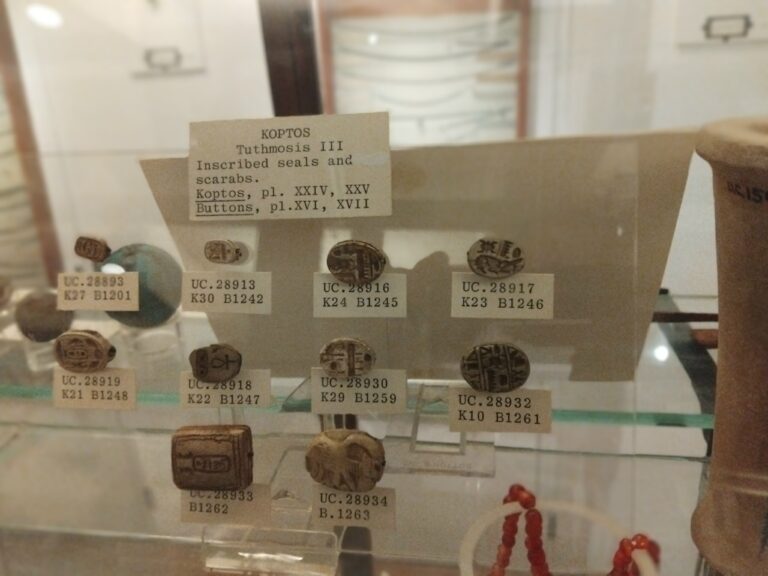
In addition to the recent discovery of his tomb, Tuthmosis II is biblically important since he is probably the Pharaoh who was reigning whilst Moses fled from Egypt after killing an Egyptian who was beating a Hebrew. Artefacts relating to Tuthmosis I who was most likely the Pharoah who gave orders for the Hebrew male babies to be killed and Tuthmosis III, the Pharaoh of the opression and probably the Pharaoh of the Exodus, can again be viewed in Egypt and in museums around the world. Amenhotep II is also a strong candidate for the Pharaoh of the Exodus.
Rameses II
The display board states that Rameses II is thought to have been the Pharaoh of the Exodus and that he had to deal with Moses and the plagues and that this gave rise to the Jewish Feast of the Passover. This view is presented widely in academia, in documentaries and also in films. However this does not concur with the biblical timeline (1 Kings 6:1; Acts 13.20; Judges 11:26). Usually Exodus 1:11 is given in support with reference to the store cities of Pithom and Rameses being built. However as one who believes in an early date for the Exodus, Genesis 47:11 tells us that Joseph’s father and brother were previously situated in the land of Rameses.
Furthermore if we once more consider the names of the pharaohs in the 18th Dynasty, there are names such as Ahmose I, Tuthmosis I, Tuthmosis II, Tuthmosis III and Tuthmosis IV. Moses was given an Egyptian name by Pharaoh’s daughter and his name resembles their names. Moreover, the last Pharaoh of the 17th Dynasty was called Kamose and the Ramesside pharaohs resided in the 19th and 20th dynasties. Tuthmosis III was probably the Pharaoh of the Exodus.
Closing thoughts-Are you ready for your exodus?
The Apostle Peter spoke of the day when he would leave his tent (2 Peter 1:15). By his tent he meant the tabernacle of his body. He also spoke of his departure, meaning his exodus from this world. When a believer in Jesus leaves this earth, they are moving home, from one place to another. John 1:14 explains that the Word became flesh and dwelt (tabernacled) among us. Jesus the Messiah, took on flesh and walked among us. One day we will all pass away and we will all meet God and stand before Him at the Judgement. Our greatest need is to have our sin forgiven and to have things put right between us and God. There is one Mediator between God and man and that is the Man, Jesus the Messiah (1 Timothy 2:5). But we must turn to Him, trust in Him and follow Him and ask Him to forgive us for our sins, before we leave our tents and make our exodus.
[i] The Jewish Study Bible JPS Tanakh (JPS, 2004; Oxford), p1397 some scholars think that Psalm 104 was adapted from the Egyptian Hymn to Aten (ANET 369-71)
[ii] Alan Cole Exodus Tyndale Old Testament Commentaries (IVP, 1973; Leicester), p214
[iii] John F. Walvoord & Roy B. Zuck (Victor, 1989; USA), p155