The British Museum possesses an enormous repository of artefacts, many of which are not currently on display and some of those relate to the Bible. It is simply not logistically feasible to exhibit every item and in addition, there is ongoing work involved in examining and deciphering texts written in Mesopotamian languages. The British Museum website has an incredibly useful collection search online, including items on display and those not currently exhibited publicly. This article will focus on six artefacts not on display, which are of biblical importance.
Amel-Marduk (Evil-Merodach) Clay Tablet (28933)[i]
This small tablet is cracked yet has survived and resembles two of the other documents in this article as a promissory note for silver and in this case, when Evil-Merodach was ruler. Evil-Merodach is mentioned twice in Scripture in 2 Kings 25:27-30 and Jeremiah 52:31-34 at the close of the respective books on the same subjects as parallel accounts.
“Now it came to pass in the thirty-seventh year of the captivity of Jehoiachin king of Judah, in the twelfth month, on the twenty-seventh day of the month, that Evil-Merodach king of Babylon, in the year that he began to reign, released Jehoiachin king of Judah from prison. He spoke kindly to him, and gave him a more prominent seat than those of the kings who were with him in Babylon. So Jehoiachin changed from his prison garments, and he ate bread regularly before the king all the days of his life. And as for his provisions, there was a regular ration given him by the king, a portion for each day, all the days of his life.” (2 Kings 25:27-30)
My old pastor once encouraged us with this concise reading drawing our attention to these verses as a ‘go to passage’ for encouragement! Believers in the Lord are freed by Him and are shown great kindness and the Lord provides for our needs and clothes us in righteousness for all our days.
As well as this tablet bringing historical attestation for Evil-Merodach, Price and House add that clay ration tablets confirm the accuracy of the biblical account. A clay tablet from the Babylonian Chronicles lists the recipients of sesame oil, including King Jehoiachin, his sons and his men.[ii]
Darius II Clay Tablet (12957)[iii]
This similar pocket-sized, cracked tablet contains an agreement about payment in silver instead of dates for fields. Darius II is only referenced once in the Bible in Nehemiah 12:22-23 “During the reign of Darius the Persian, a record was also kept of the Levites and priests who had been heads of their fathers’ houses in the days of Eliashib, Joiada, Johanan, and Jaddua. The sons of Levi, the heads of the fathers’ houses until the days of Johanan the son of Eliashib, were written in the book of the chronicles.”
Darius II was the son of Artaxerxes I and attributed his successes to Ahura Mazda. Bryan Windle from the Biblical Archaeological Review cites an article by Herbert Paper listing a part of the longest inscription from Ecbatana recorded on a gold tablet.
“I am Darius the great king, king of kings, king of countries having many kinds of men, king in this great earth far and wide, son of Artaxerxes the king, of Artaxerxes (who was) son of Xerxes the king, of Xerxes (who was) son of Darius the king, an Achaemenian. Saith Darius the king: Ahuramazda bestowed this land on me. I am king in this land–may Ahuramazda protect my royal house and the kingship which he bestowed upon me.”[iv]
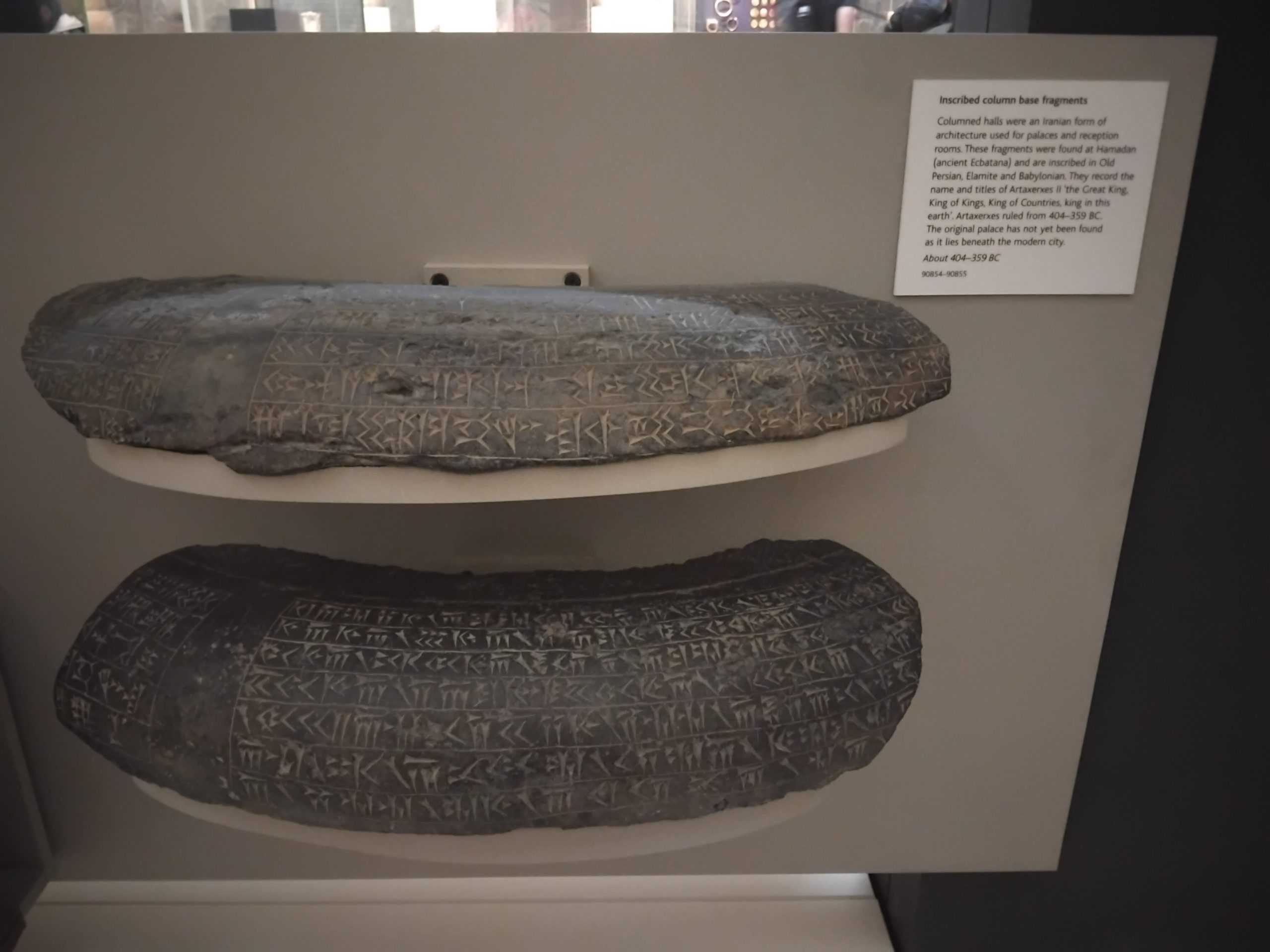
This inscription not only provides insight into Darius’ reign and power over nations but also provides historical attestation for three other biblical kings, Artaxerxes I, Xerxes I and Darius I. Similarly in Room 52 there is a column base of Artaxerxes II (90854/90855) that names Darius II as his father.
Archive of Tattannu (Tattenai) Clay Tablet (85576)[v]
This next small clay tablet contains another promissory note for silver confirming Tattenai historically. In Ezra 5-6 there is a dramatic turnaround concerning Tattenai in regard to the building work in Jerusalem. Initially as governor of the region beyond the River, Tattenai questioned the work of building the temple and completing the wall and even aimed to halt it. “At the same time Tattenai the governor of the region beyond the River and Shethar-Boznai and their companions came to them and spoke thus to them: “Who has commanded you to build this temple and finish this wall?”(Ezra 5:3) The Lord enabled them to continue with the work until a report could be sent to Darius.
However, Tattenai sent a letter to Darius I, making careful enquiry into who had initially authorised the work. A search was made and it was re-discovered that Cyrus had originally issued a decree concerning the house of God in Jerusalem. Darius I, ordered that the work continue and the cost be paid at the king’s expenses from taxes and whatever was required for offerings and sacrifices. Furthermore Darius I ordered that whoever altered the edict would be hung from their own house and that the work should be carried out diligently! Tattenai and his companions then diligently did according to what Darius had decreed.
Nabonidus Cylinder (91128)[vi]
This fired-clay cylinder is of excellent quality and is well-preserved. Although I cannot read cuneiform it is obvious that the text is clearly embedded. It describes the work on the temple of the moon god Sin at Ur by Nabonidus and includes a prayer for him and crucially for his son, Belshazzar.
There are also a few items relating to Nabonidus and Belshazzar on display in Room 55 at the British Museum, together with most insightful information boards drawing interest to the biblical significance. In Daniel Chapter 5, Belshazzar hosts a feast for a thousand of his lords and they used the gold vessels that were taken from the temple in Jerusalem. In the same hour, the writing was on the wall as a man’s hand appeared and wrote opposite the lampstand on the plaster of the wall. No one was able to read the writing or interpret the meaning. Hence Daniel was called into interpret the message. Belshazzar had been numbered and finished his kingdom was finished, he had been weighed in the balances and found wanting and his kingdom would be divided and given to the Medes and the Persians. That night Belshazzar was slain and Darius the Mede received the kingdom.
This information helps us to piece together a previous mystery. In Daniel 5:29, Belshazzar appoints Daniel as the third ruler in the kingdom. In Genesis 41:40, Joseph who in some ways resembles Daniel with his God given ability to interpret dreams and rise to great authority was appointed as second in command, only to Pharaoh. Why was Daniel appointed as third in the kingdom? Nabonidus and Belshazzar had a co-regency which was not uncommon in the ancient world especially when a new or a young ruler took command, probably to ensure stability and that they governed wisely when suddenly receiving tremendous responsibility.
Neriglissar (Nergal-Sarezer) Cylinder (90913)[vii]
This clay cuneiform cylinder concerns the repair of the Libil-Hegalli canal at Babylon in two columns. It is not as well preserved or as clear as the Nabonidus Cylinder. Nergal-Sarezer became king of Babylon although he is certainly one of the lesser-known characters in the Bible. He is referred to in Jeremiah 39:3-13. Noticeably in Jeremiah 39:3 there appears to be two characters of the same name as princes of King Nebuchadnezzar.
“Then all the princes of the king of Babylon came in and sat in the Middle Gate: Nergal-Sharezer, Samgar-Nebo, Sarsechim, Rabsaris, Nergal-Sarezer, Rabmag, with the rest of the princes of the king of Babylon.”
Kennedy notes that in Jeremiah there may either be two officials or he may have been mentioned twice regarding his respective titles.[viii] Notably in Jeremiah 39:13-14, there is just a single reference to Nergal-Sharezer alongside the other princes.
“So Nebuzaradan the captain of the guard sent Nebushasban, Rabsaris, Nergal-Sharezer, Rabmag, and all the king of Babylon’s chief officers; then they sent someone to take Jeremiah from the court of the prison, and committed him to Gedaliah the son of Ahikam, the son of Shaphan, that he should take him home. So he dwelt among the people.”
The account in Jeremiah states that the Chaldean army captured King Zedekiah, killed his sons before his eyes and then put his eyes out. Fascinatingly King Nebuchadnezzar then gave Nebuzaradan the captain of the guard instructions to take Jeremiah, look after him, do him no harm but to do exactly as he says to him. It is at this point that Nebuzaradan sent the princes to take Jeremiah from the court of the prison and that he should be taken home and dwell with his people.
Merodach Baladan II Fired-Clay Brick (90269)[ix]
This brick is surprisingly long, broad and hefty and the part with an inscription in the middle approximates to the size of a house brick. In 2 Kings 20:12-19 and Isaiah 39:1-7, King Hezekiah received a present and letters from Merodach-Baladan since he heard that Hezekiah was sick. Hezekiah then proceeded to show Merodach Baladan all the house of his treasures including silver, gold, spices, precious ointments and all his armoury. Isaiah then enquired of Hezekiah concerning that and subsequently announced that all that was in his house and that his fathers had accumulated would be carried to Babylon and nothing would be left. They would even take away some of his sons and they would become eunuchs in the palace of the king of Babylon.
Kennedy notes that Merodach Baladan II is well attested in ancient sources including the Barrel Cylinder of Marduk-Apla-iddina, the Babylonian Chronicle, the Annals of Sargon and the Bavian Rock Inscription of Sennacherib.[x]
When we look at additional sources, inscriptions and artefacts and then compare them with the Bible we see a clear picture of events relating to the exile in Babylon and characters mentioned in the Bible in relation to that.
Closing thoughts
At most museums it is rare to find a connection made with artefacts displayed and characters referred to from the Bible. The British Museum draws much more attention to biblical characters and references than most other museums and this is clearly evident by the quality of their information boards. Often it is the case that biblical archaeology is hidden in plain sight and the dots need to be joined to connect ancient history with biblical history.
Excitingly, there are many objects that relate to the Bible that are contained at museums that are not on display. By searching through the respective collections online, it is possible to obtain valuable information readily. Often the names vary, either through transliteration or various rendering of names, so it is definitely worth searching under several names, spelling variants and also comparing the dates of their reigns and their family lineage.
All of the six artefacts above make an important contribution to biblical archaeology and support the historicity and reliability of the biblical record. It is useful to undertake extensive investigations since the more we examine these artefacts the easier it is to piece together a jigsaw of interrelated characters from the Bible rooted in history helping us to understand the Bible and to have complete confidence in the Scriptures and in the Lord.
[i] https://www.britishmuseum.org/collection/object/W_1898-1112-109
[ii] Randall Price & H. Wayne House Zondervan Handbook of Biblical Archaeology (Zondervan Academic, 2017; Grand Rapids), p139
[iii] https://www.britishmuseum.org/collection/object/W_1896-0328-48
[iv] Bryan Windle June 27th, 2025 Darius the Persian: An Archaeological Biography https://biblearchaeologyreport.com/2025/06/27/darius-the-persian-an-archaeological-biography/ citing Herbert H. Paper. “An Old Persian Text of Darius II (D2Ha).” Journal of the American Oriental Society, vol. 72, no. 4, 1952, pp. 169–70. JSTOR, https://doi.org/10.2307/596379, (Accessed June 21, 2025).
[v] https://www.britishmuseum.org/collection/object/W_1899-0415-383
[vi] https://www.britishmuseum.org/collection/object/W_K-1692
[vii] https://www.britishmuseum.org/collection/object/W_-90913
[viii] Titus Kennedy Archaeology and the People of the Bible (Harvest House, 2026; Eugene, Oregon), p192
[ix] https://www.britishmuseum.org/collection/object/W_1851-0101-282
[x] Kennedy, p126