Zion is mentioned 176 times in the NKJV. This psalm emphasizes the importance of Zion, although it is longer than the other songs of ascent and is different in style.[i] It draws heavily from the Davidic Covenant in 2 Samuel 7 and also relates to Psalm 89 where the Davidic Covenant is remembered and both David and David’s greater Son, the Messiah are in view.
Commentators are divided concerning its authorship, although many sound expositors consider Solomon to be the most likely author. Wiersbe notes, “Since verses 8-10 are quoted by Solomon in his prayer at the dedication of the temple (2 Chron.6:41-42), perhaps this psalm was written for that occasion.”[ii] McGee observes, “Delitzch says, “It is suited to the mouth of Solomon.” Perowne says, “It is perfectly natural that Solomon should write a song for such an occasion, speaking of the earlier efforts by his father to prepare a habitation…”[iii]
The psalmist who I consider most probably to be Solomon, commences with a prayer asking the Lord to remember David and all his afflictions. Some consider this to also include the afflictions of David when he was pursued by Saul, in addition to the afflictions concerned with enabling the temple to be built in Jerusalem. The word ‘afflictions’ here, according to Strongs Concordance relates to the word ‘anah’ of which there are 83 occurrences in connection with ‘to afflict, oppress, humble, answer and respond’.[iv]
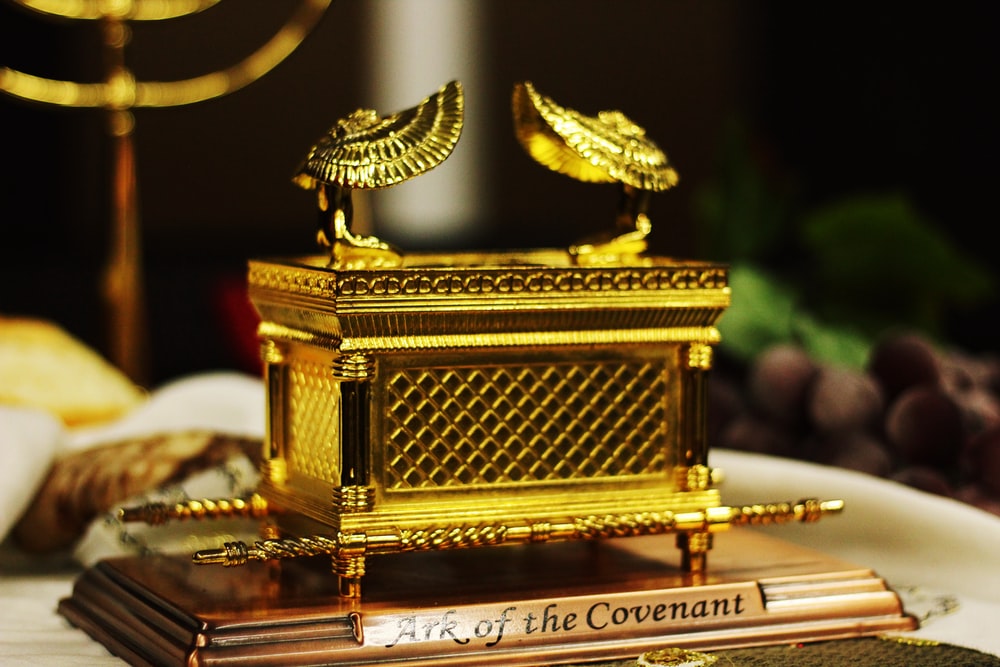
The Ark of the Covenant moved to the temple
However, in view of the immediate context in verses 1-9 where David has an urgent and restless desire to build the Lord a house and is highly conscious of the comfort of his own abode combined with the details of the whereabouts of the ark, this setting seems to be the source of his afflictions. We should not forget that when the ark of God was transported to Jerusalem, Uzzah steadied the ark and died that day and also David was afraid of the Lord that day (2 Samuel 6:6-9). We should keep in mind the particular responsibilities and concerns pertaining to David’s position as the King of Israel.
David is mentioned in verse 2 in relation to making a vow to the God of Jacob, but it is not easy to conclusively identify that particular vow. There is a helpful marginal reference in the NKJV Reference Edition Bible to Psalm 65:1, which is noticeably a psalm of David and states, “Praise is awaiting You, O God, in Zion; And to You the vow shall be performed. O You who hear prayer.” Psalm 65:4 corresponds, “Blessed is the man You choose, And cause to approach You, That he may dwell in Your courts. We shall be satisfied with the goodness of Your house, Of Your holy temple.” Without being overly dogmatic, the vow may well be regarding David’s restless desire to build the Lord a temple even though his son Solomon would undertake and complete the task.
David was the King of Israel yet he refused his own comforts, even sleep, until he found a dwelling place for the Lord. Do we put our needs above God’s glory? Are we willing to humble ourselves that the Lord might lift us up (James 4:10)? Vows should not be undertaken lightly and we should follow through on what we say and even a pledge or a surety, should not be uttered lightly (Proverbs 6:1-5). Wiersbe insightfully adds, “Unless God is on the throne in our lives, no enterprise we attempt can be really successful.”[v]
This vow was to the Mighty One of Jacob. Ibn Ezra makes an interesting connection with Jacob’s vow at Bethel which means ‘House of God’ when Jacob stated in Genesis 28:17, “This is none other than the house of God, and this is the gate of heaven!”[vi]Some commentaries and reference Bibles identify the link between Psalm 132:2 and Jacob’s last words for his sons in 49:24, “By the hands of the Mighty God of Jacob (From there is the Shepherd, the Stone of Israel).” This looks forward to Messiah’s coming which again is integral to the Davidic Covenant and Psalm 132. At the end of his mini-section, Psalm 132:5 closes with, “Until I find a place for the Lord, A dwelling place for the Mighty One of Jacob.”
Verse 6 is perhaps perplexing to the western reader, or those not thoroughly acquainted with the geography of Israel. “Behold we heard of it in Ephrathah; we found it in the fields of the woods.” Nonetheless if we keep the immediate context in mind and follow that through to the location, the meaning becomes clearer. David was understandably anxious about moving the ark of the covenant to Jerusalem where it would later be housed in the temple. Ephrathah relates to the ancient name for Bethlehem Ephrathah (Genesis 35:19) which is located 5 miles below Jerusalem. The Amplified version sheds some helpful light. “Lo, at Ephrathah we (first) heard of (the discovered ark); we found it in the fields of the wood-at (Kiriath-) Jearim. (1 Samuel 6:21).[vii]
The NKJV Reference Edition Bible has a marginal Hebrew note, stating Jaar, lit. woods and Macdonald adds, Kirjath-Jearim, means ‘the city of the woods’.[viii] The ark was returned to Israel but remained at Kirjath Jearim for twenty years (1 Samuel 6:20-7:2). The following verse in our passage, Psalm 132:7 implores us to go to the Lord’s tabernacle and worship at His footstool.
Undoubtedly Solomon’s temple would have been simultaneously impressive and inspiring, but it’s importance was far beyond an exquisite architectural marvel! We should again cast our minds back to the establishment of the Davidic Covenant in 2 Samuel 7 where despite David’s noble intentions, the Lord asked, “Would you build a house for Me to dwell in ?”(2 Samuel 7:5) The Lord had not dwelt in a house since He brought the children of Israel up from Egypt but moved about in a tent and a tabernacle.
Similarly Isaiah stated, “Thus says the Lord: “Heaven is My throne,
And earth is My footstool. Where is the house that you will build Me?
And where is the place of My rest?For all those things My hand has made,
And all those things exist, ”Says the Lord.
“But on this one will I look: On him who is poor and of a contrite spirit,
And who trembles at My word.” (Isaiah 66:1-2)
Worshipping in the temple
The Pyramid of Giza is the oldest and only surviving ‘ancient wonder of the world’, yet it was not the dwelling place of the God of Jacob. Thus we are reminded that we are fashioned by our Creator to worship at His footstool. By worshipping we are expressing the worth of the Person and object of our worship and ascribing greatness unto Him. Since we are made by the Lord and for Him, we will find our ultimate fulfilment in Him. The wonder of the incarnation is that the Lord took on flesh and dwelt (tabernacled) among us (John 1:14).
This prayer in verse 8, “Arise, O Lord, to Your resting place, You and the ark of Your strength.” draws from Moses’ words in Numbers 10:35-36, “So it was, whenever the ark set out, that Moses said:
“Rise up, O Lord! Let Your enemies be scattered, And let those who hate You flee before You.”
And when it rested, he said: “Return, O Lord, To the many thousands of Israel.” These prayers were heard and answered although the Davidic Covenant continues and there is more in view in this psalm regarding Messiah’s return.
In the context of worship in the temple, the psalmist desires that the Lord’s priests be clothed with righteousness and that His saints shout for joy. Only the Lord can make someone righteous. It is not something we can achieve through our own efforts. He created us and He can also make us righteous and salvation is from the Lord. By trusting in Messiah for our salvation, we can also ask Him to make us righteous.
“I will greatly rejoice in the Lord, My soul shall be joyful in my God;
For He has clothed me with the garments of salvation, He has covered me with the robe of righteousness, As a bridegroom decks himself with ornaments,
And as a bride adorns herself with her jewels. For as the earth brings forth its bud,
As the garden causes the things that are sown in it to spring forth,
So the Lord God will cause righteousness and praise to spring forth before all the nations. “(Isaiah 61:10-11)
The hope that the saints shout for joy surely reminds us of 1 Samuel 4:5, “And when the ark of the covenant of the Lord came into the camp, all Israel shouted so loudly that the earth shook.” The first nine verses of this psalm were a prayer and the second part of this psalm directs us to the Lord’s covenant promises which the Lord would answer.
Solomon prayed for David’s sake, not to turn away the face of His Anointed. Rashi interprets this as not to turn His face away from His anointed Solomon, when he comes to place the Ark therein.[ix]Nevertheless, if we turn back to the Davidic Covenant, Solomon is in view, but so also is Messiah, since the house and kingdom would be established forever. Flanigan states, “For so long there has been no king or kingdom, and no throne. This is however, but a suspension of the promise, not an abandonment or abrogation of it, and, when Israel shall once again be repentant and obedient, then in that day, Messiah, the Son of David, will occupy the throne in fulfilment of the covenant.[x] Similarly, Unger writes, “The Lord’s oath, sworn in truth (2 Sam.7:28) that of the fruit of David’s body He would set upon His throne, has its ultimate fulfilment in the Messiah and His millennial reign (Luke 1:32-33, 69; Acts 2:30-31).[xi]
The Lord has chosen Zion
This psalm shows the centrality of the Lord’s purposes in Jerusalem in relation to the Davidic Covenant and Messiah. Ibn Era states, “It mentions Zion because it is called the city of David, since he rejoiced when it was revealed to him that the mountain of the House of the Lord is Zion.”[xii]Malbim says, “For the Lord has chosen Zion-Because of the choice of the seed of David was for the sake of the choice of Zion as I explained above. And it says that in the beginning God chose Zion in the sense of a choice which excludes all other places, and afterwards, ‘He desired it for His habitation,’ He desired the place in and of itself without looking at it in relation to rejecting anywhere else.”[xiii]In addition MacArthur succinctly writes, “This refers to earthly Jerusalem.”[xiv]
We must keep in mind that the Lord chose a people for Himself (Deuteronomy 7:7-9; 14:2; cf. Romans 11:1) and that the Lord is a faithful covenant keeping God. He also chose Zion and His purposes are being worked out and will be accomplished. He chose Jerusalem for His resting place. Notwithstanding, the gospel is for the Jew first and then the Gentile (Romans 1:16) and only Messiah can save.
Psalm 132:14 reads, “This is my resting place forever; Here I will dwell, for I have desired it.” There is a useful cross reference in Psalm 68:15-16. The context of Psalm 68 is the glory of God in His goodness to Israel and the mountains of Bashan are compared with Jerusalem. “A mountain of God is the mountain of Bashan; A mountain of many peaks is the mountain of Bashan. Why do you fume with envy, you mountains of many peaks? This is the mountain which God desires to dwell in; Yes, the Lord will dwell in it forever.” Psalm 68:18 foretells Yeshua’s (Jesus’) ascension. “You have ascended on high, You have led captivity captive; You have received gifts among men, Even from the rebellious, That the Lord God might dwell there.” Jesus departed to heaven from the Mount of Olives and that is also where He will return (cf. Acts 1:9-12; Ephesians 4:8).
Solomon’s prayers are heard and answered in the closing verses and that gives us the assurance that if we ask according to His will, then the Lord will hear and answer our prayers too. The Lord would clothe her priests with salvation and the saints would shout aloud for joy and the Lord would not turn His face away from His Anointed since the horn of David would grow and He would prepare a lamp for His anointed. The strength of David would sprout (Ezekiel 29:21; cf. Luke 1:69) and the lamp of Israel would never go out (1 Kings 11:36; 15:4;).
The Lord shall return to Zion
This psalm closes with His enemies being clothed with shame but upon Himself, His crown shall flourish. The Lord has kept His Covenant with David and He has chosen Zion. Jesus is David’s greater Son who brought salvation through His atoning sacrifice to reconcile man to God. We can approach a holy God through Messiah. Do you seek to worship at His footstool? Have you been clothed with His righteousness, or are you clothed with shame? Have you asked Him to forgive your sin? He shall return to the Mount of Olives, which is exactly where He left. So, are you ready for His return?
[i] The Jewish Study Bible JPS Tanakh (Oxford University Press, 2004; Oxford), p1431
[ii] Warren W. Wiersbe The Wiersbe Bible Commentary The Complete Old Testament (David C. Cook, 2007; Colorado Springs), p1032
[iii] Vernon McGee Thru the Bible Commentary Series Psalms 90-150 (Thomas Nelson, 1991; Nashville), p131
[iv] https://biblehub.com/hebrew/6031.htm
[v] Wiersbe, p1032
[vi] Ibn Ezra on Psalm 132:5 https://www.sefaria.org/Psalms.132.5?lang=bi&p2=Ibn_Ezra_on_Psalms.132.6.1&lang2=bi
[vii] The Comparative Study Bible A Parallel Bible presenting the New International Version, New American Standard Bible, Amplified Bible, King James Bible (Zondervan, Grand Rapids; 1984), P1490
[viii] William MacDonald Believer’s Bible Commentary (Thomas Nelson, 1995; Nashville), p761
[ix] Rashi on Psalm 132:10 https://www.sefaria.org/Rashi_on_Psalms.132.10.1?lang=bi
[x] J. Flanigan Ritchie Old Testament Commentaries What the Bible Teaches Psalms (John Ritchie, 2001; Kilmarnock), p572
[xi] Merrill F. Unger Unger’s Complete Commentary on the Old Testament (AMG, 2002; Chattanooga), p955
[xii] Ibn Ezra on Psalm 132:13 https://www.sefaria.org/Psalms.132.13?lang=bi&with=Ibn%20Ezra&lang2=en
[xiii] Malbim on Psalm 132:13 https://www.sefaria.org/Malbim_on_Psalms.132.13.1?lang=bi
[xiv] John MacArthur The MacArthur Bible Commentary (Thomas Nelson, 2005; Nashville), p687


