Subsequent visits to the Ashmolean Museum in Oxford have provided further insight relating to the Bible. Often people marvel at the antiquity, scale and diversity of objects that are viewable and how they were acquired for the museum. Near the reception there is a large carved slab of an Assyrian protective spirit presented to Oxford University by Austen Henry Layard. That was one of a pair guarding a doorway into the royal throne room at the Northwest palace at Nimrud. The carved slab contains a cuneiform inscription mentioning the achievements of King Ashurnasirpal II. Although he is not mentioned in the Bible, he would have been concurrent with King Ahab (874-853BC) who has been confirmed archaeologically.[i] Layard also discovered a vast number of artefacts and many of those confirm the historicity of Bible characters.
Room 19
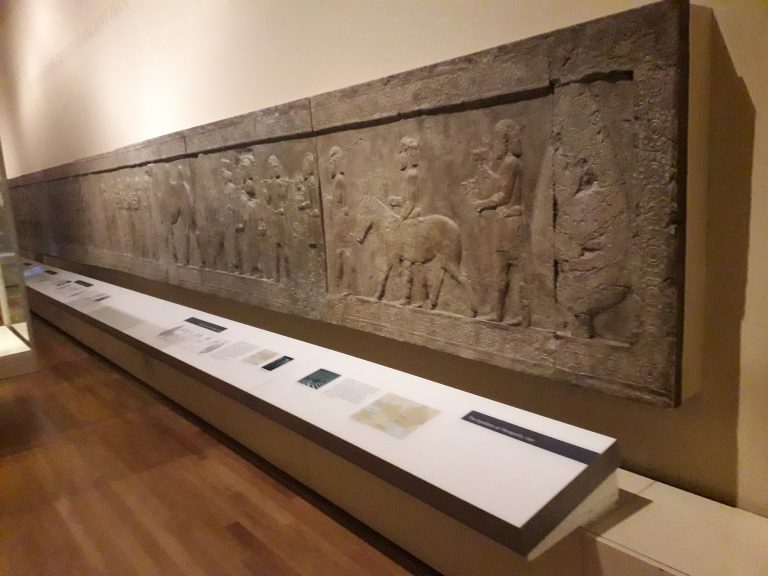
In Room 19 an information board contains a sketch of a lamassu (colossal creatures that have a bearded human-head with wings and the body of either a bull or a lion)[ii]. It is about to be transported from Nimrud in 1847 with teams of men bearing the weight on ropes. Layard discovered lamassus which were placed guarding the palace of Sargon II (Isaiah 20:1). For some items Layard also employed marble cutters and had these huge sculptures shipped to the British Museum.[iii] A section of the Southwest Palace at Nineveh where Sennacherib resided was previously kept for many years at Canford School in Dorset but has been reunited with the other parts of the wall.
In Room 19, near to the Sumerian King List (Weld-Blundell Prism) and the fragment relating to the Gilgamesh epic, there are two small mathematical tablets, one with a multiplication table and the other a calculation for the area of a triangle. These items challenge the presuppositions of some concerning the prominence of writing and the advanced abilities of those from earliest civilizations. To calculate the area of a triangle, one must do so using a base of 60 rather than 10. This reminds me of my old Bible lecturer who drew attention to the Babylonians using a sexagesimal system citing Daniel 3:1 in support. Also bear in mind, seconds, minutes and hours and the degrees used for geometry which originate from the Babylonian system. “Nebuchadnezzar the king made an image of gold, whose height was sixty cubits and its width six cubits. He set it up in the plain of Dura, in the province of Babylon.”
Room 23
Perhaps surprisingly, there are more pyramids in Sudan than in Egypt. Room 23 is dominated by the colossal shrine for Tarharqa (690-664) and Nubia. Tarharqa resided in the Cushite Dynasty (25th Dynasty of the list of Pharaohs of Ancient Egypt) which consisted of five Cushite rulers[iv] and he is the most famous of that period. Many objects relating to him can be seen at the Ashmolean Museum as well as the British Museum and the Louvre. He is referred to in the parallel accounts of 2 Kings 19:9 and Isaiah 37:9 as making his way to aid Hezekiah against Sennacherib before Sennacherib approached Jerusalem.
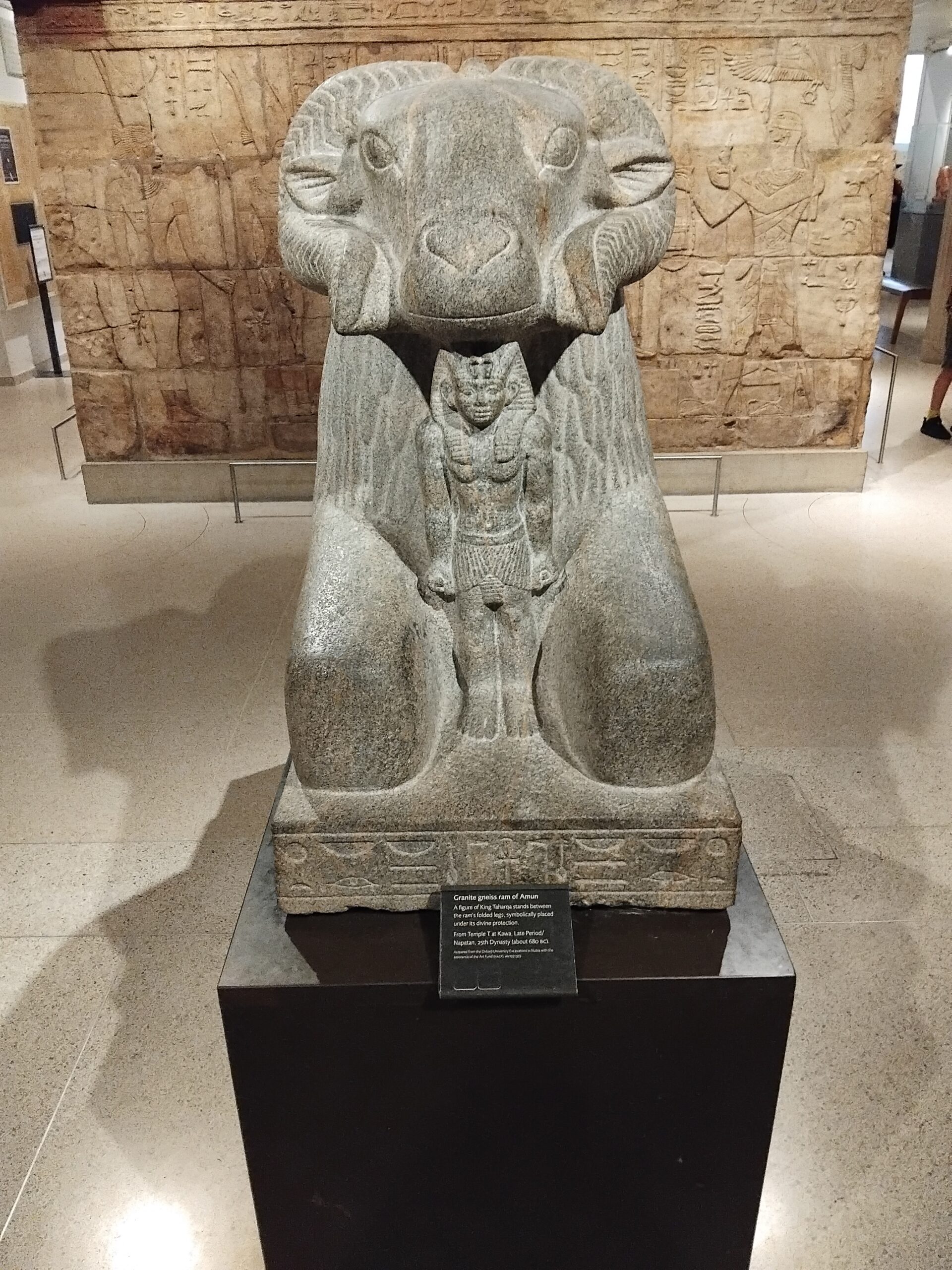
There is a rock sculpture of Tarharqa nestled underneath Amun, a ram-headed god, symbolising protection from it. Amun was combined with Ra to become Amun-Re[v] and was considered the chief of the gods of the Egyptian pantheon. Hence the sculptures make a bold and emphatic statement concerning the extent of Taharqa’s power. A similar sculpture can be seen in the British Museum. Behind the granite sculpture in the Ashmolean Museum one can view the west wall of the Tarharqa shrine. Here Amun-re is depicted anthropomorphically with a human body and ram’s head seated on the throne. The information board explains that Tarharqa is standing before him and offering a loaf, a neckclase, a pectoral and a figure of Ma’at to him. Behind that throne, there are three standing goddesses.
The information boards for this shrine are really helpful and provide mini diagrams relating to the respective walls to identify and convey the meaning. On the north wall of the shrine the god Ptah-Nun-Wer actually embraces Tarharqa. On the other side Tarharqa stands before Sekhmet and Nefertum-Horakhty. Symbols representing life, stability and power are extended towards him. On the east wall of the Shrine of King Taharqa offers a white loaf to his father Amun-Re. Behind the throne Mut, Khonsu and Montu are standing. Finally on the south side of the shrine, there is a granite statue of Tarharqa in an enclave. He is holding a crook and a flail denoting authority and kingship.
There is also a display case of many of Tarharqa’s objects from the Sanam Temple which he built, many of which relate to various gods including Amun-Re. In another display case relating to the Kingdom of Kush, there is a sandstone block from the hypostyle hall of Temple T at Kawa, that Taharqa completed.
In a display case entitled ‘New Kingdom Nubia’ most of the objects originate from a sanctuary dedicated to the goddess Hathor, built at Faras by Queen Hatshepsut. Hatshepsut is one of the most famous Egyptian rulers and other objects relating to her can be seen at the British Museum and the Louvre in addition to her mortuary temple in the Valley of the Kings. She may well have been the daughter of Pharaoh who took pity on Moses and raised him in Exodus 2.
On the back wall of Room 23, there is a sandstone stela of Nero as an Egyptian King making an offering to the god Min. Nero is the unnamed Caesar of Acts 25-26 and Acts 28:19. Roman emperors dressed in Egyptian attire are not an unusual phenomenon. During the Roman Period, Egypt became part of the Roman Empire and Roman Emperors would assume the title of Pharaoh. Similar stelas can be viewed in Room 4 in the British Museum of the emperors Tiberius (Luke 3:1) and Domitian again dressed in Egyptian attire and making offerings to respective gods. In Room 52 of the British Museum, King Darius I (Zechariah 1:1) is performing a similar role during the 27th Dynasty of Egypt under Persian rule.
Room 26
An information sign labelled, ‘Oracular Judgement of Seth’ which is more formally known as the Dakhla Stela lists oracles from the god Seth, to settle a land dispute involving a priest named Nesubast. That stela is dated to the fifth year of the reign of Sheshonq I (c. 940BC), who was the first King of the Libyan (22nd Dynasty). Sheshonq I is the biblical Shishak (1 Kings 11:40; 14:25; 2 Chronicles 12:2-9) and he was a contemporary of Solomon, Jeroboam and Rehoboam.
Solomon began to build the temple in Jerusalem in the fourth year of his reign which was four hundred and eighty years after the Exodus (1 Kings 6:1). In 1 Kings 11:40, Solomon sought to kill Jeroboam, (because he had rebelled against Solomon), so he arose and fled to Egypt, to Shishak, King of Egypt and was there until the death of Solomon. Later in 1 Kings 14:25, in the fifth year of Rehoboam, Shishak King of Egypt came up against Jerusalem. 1 Kings 14:26 explains that Shishak took away the treasures of the house of the Lord and the King’s house. The Bible is exceptional among ancient literature since it records the military losses and embarrassing details concerning Israel and Judah, not just victories, unlike other empires and nations that often omit losses or humiliating defeats from their records. An example of that is the defacing of pharaohs by subsequent pharaohs visible on sculptures in museums and monuments today. Many items relating to Queen Hatshepsut’s monuments were defaced by Tuthmosis III.
Room 7
Room 7 relates to coins and in the section relating to Rome, there are three rows of coins in the glass display case. It is the top row consisting of five coins that is of biblical interest. The first coin relates to Tiberius restoration of the temple of Concordia in Rome by the Emperor Tiberius. The second coin depicts Nero in court. The writing on that coin is clear and ‘Caesar’ is easily visible. The third coin is Nero’s triumphal arch over the Parthians. The fourth coin displays Vespasian’s suppression of the Jewish revolt, showing a woman mourning under a palm tree. ‘Iudaea’ which is ‘Judea’ written in Latin is quickly recognisable on that coin. The fifth coin depicts Domitian as the chief priest sacrificing at the inauguration of a new age. Domitian was probably the emperor when John was exiled to Patmos.
Finally, closer to home, there is a glass case with an exhibit entitled, ‘Romans in Britain.’ Of those coins the ones of most biblical and Jewish interest are that of Claudius Caesar and Hadrian. If you tilt your head, ‘Claudius Caesar’ is readable on Claudius Caesar’s coin. Emperor Hadrian sadly forbade circumcision, suppressed the second Jewish revolt and renamed Judea, Syria Palestine. On the other side of the same glass case there is a coin relating to Claudius’ triumphal arch with ‘De Britiann’ clearly marked on the arch in the centre of the coin.
Closing thoughts
All the above illustrates the historicity and the reliability of the Scriptures. Countless people have an interest in ancient history, archaeology, especially Egyptology and even the Bible, yet still do not know God. It is vitally important to know, trust and follow the God of Abraham, Isaac and Jacob. He is the One who is able to foretell events before they come to pass and the One who knows the end from the beginning and the One who knows and understands us, better than we know ourselves.
[i] Lawrence Mykytiuk 53 People in the Bible Confirmed Archaeologically August 31st 2025 https://www.biblicalarchaeology.org/daily/people-cultures-in-the-bible/people-in-the-bible/50-people-in-the-bible-confirmed-archaeologically/#note18r
[ii] Everett Munez Lamassu Guardian Sculpture Britannica https://www.britannica.com/topic/lamassu
[iii] Austen Henry Layard Nineveh and its Remains (Pantianos Classics, First Published in 1948), p84
[iv] Teagan Wolter List of Pharaohs of Ancient Egypt https://www.biblicalarchaeology.org/daily/people-cultures-in-the-bible/people-in-the-bible/50-people-in-the-bible-confirmed-archaeologically/#note18r
[v] Ram of Amun-Re Ashmolean Museum Oxford https://www.ashmolean.org/ram-of-amun-re